• +228 872 4444
  • +775 872 4444
  • contact@email.com
Arya Kshema Winter Debates
  • Home
Sign In

Day 7: The Blessings of Many Authentic Gurus

Jacek Rosa 2021 Arya Kshema 02 September 2026

Arya Kshema Spring Dharma Teachings:
17th Gyalwang Karmapa on The Life of the Eighth Karmapa Mikyö Dorje

February 24, 2021

After a two-day break, His Holiness the 17th Gyalwang Karmapa continued teaching on the extraordinary life and Dharma activities of the Eighth Karmapa Mikyö Dorje. Again taking up the topic of "following the gurus," he started by addressing the third stanza of The Praise "He Searched Thoroughly . . .." 

When he realized that all wishes for here and the everlasting
Come from the holder of all, the spiritual friend,
Irreversible longing swelled to perfection.
His faith became transcendent—to him I pray.

Shamar Könchok Yenlak's commentary states that this stanza concerns "how he followed the guru." The main point of this teaching is that the spiritual friend provides the foundation for the entire path. Following an authentic guru is the life force for all of us who embrace the Dharma, and Mikyö Dorje exemplified this wisdom. As His Holiness mentioned the other day, the Eighth Karmapa had four main teachers, including Sangye Nyenpa, for whom he had great devotion. When Nyenpa Rinpoche passed away, Mikyö Dorje erected a memorial statue to him. Later it was brought to Tsurphu Monastery and became known as the "space statue." Normally when the remains of someone are brought to the charnel grounds, the Eighth Karmapa Four Session Guru Yoga is recited. During this time, this statue is brought to the ceremonies and then returned to the monastery. So it is a very sacred statue.

Among the four teachers of Mikyö Dorje, Gyaltsap Tashi Namgyal is not mentioned as one of them, but—as we have seen—he was also very kind to the Eighth Karmapa. He recognized and enthroned Mikyö Dorje and gave him the fasting vows of the Mahayana and the vows of going forth. He was the first of all the lamas that Mikyö Dorje followed in his lifetime.

At this point, the Karmapa showed portraits of Mikyö Dorje's teachers and gave their dates. He began with a picture of Gyaltsap Tashi Namgyal from an old thangka kept in the labrang of Gyaltsap Rinpoche, probably painted during the time of the Sixth Gyaltsap Rinpoche. Gyaltsap Tashi Namgyal lived from 1487 to 1515, only 29 years. His long hair indicates "not the best conduct," said His Holiness. Next he showed pictures of Mikyö Dorje's subsequent lamas—the four "official" ones. Sangye Nyenpa Rinpoche's image was taken from the Golden Garland of the Kagyu. Nyenpa Rinpoche may have been born some time around 1457 and lived to 1525. Then came Dulmo Tashi Öser, whose dates are difficult to find. His Holiness showed a statue that captured what he looked like. Khenchen Chödrup Senge, 1451 to 1530, was his third teacher, who gave Mikyö Dorje full ordination. His Holiness concluded his visual presentation with Mikyö Dorje's fourth teacher, Karma Trinleypa, who lived from 1456 to 1531, and whose picture he will include in the next teaching.

Dulmo Tashi Öser 

Having covered the biographies of Gyaltsap Tashi Namgyal and Sangye Nyenpa in the previous teaching, His Holiness spent the rest of this session on Mikyö Dorje's three other teachers, beginning with Dulmo Tashi Öser. He was a direct disciple of the Seventh Karmapa, Chödrak Gyatso, and was considered very venerable throughout Ü Tsang and Kham. He kept his vows very purely, first studying at Ganden, a Gelukpa monastery, where he was well-educated in the sutras and tantras, before becoming a student of the Seventh Karmapa. Born in Dritö near Yushu, he was the son of the Dulmo Lord [originally Dumo]. We don't know the year he was born, and he has no separate namthar. His life does appear in the Golden Garland of Kagyu Biographies and the Feast of Scholars. He met the Seventh Karmapa when he was young and was given the name Tashi Öser, as well as a transmission of the mani mantra. Chödrup Sangpo gave him full ordination in the Khenchen Shakya Shri tradition of vows, as well as the empowerment of Chakrasamvara. Returning to Kham, he took the southern route and met Chödrak Gyatso at Namtö Mountain in Kongpo. Receiving the Karmapa's blessings, he felt uncontrollable faith and gave up the idea of going back to his homeland. Tashi Öser stayed with Chödrak Gyatso and received instructions on Mahamudra, the Six Yogas of Naropa, Pointing Out the Three Kayas, and many other texts. In particular, Chödrak Gyatso gave him his own incomplete commentary on the Prajnaparamita Sutra. Well-educated by the Seventh Karmapa, Tashi Öser went to Central Tibet and gained renown in public debates and discussions. From Situ Tashi Paljor, he received the five sets of five deities of Dusum Khyenpa and the cycles of Bernakchen. He also practiced diligently in mountain retreats.

Regarding the five sets of five deities, His Holiness emphasized that this is something we really have to know very well. He mentioned the other day that one of Dusum Khyenpa's main activities was founding the three main seats of the Karma Kagyu. Another contribution was the five sets of five deities. What are they? The five deities of Vajravarahi, the five deities of Chakrasamvara, the five deities of Hevajra, the five deities of Hayagriva and the five deities of Tara. We should be able to name them if someone asks us, or we will be embarrassed!

Later, Tashi Öser went to Surmang, Ga, Denma, Drichu Lhogyü, and Kyapdü, and performed great activities in these places. He instructed on the Profound Inner Principles and several other teachings from the lineage. He imparted all that he had learned from Chödrak Gyatso, just as if he were pouring from one vase into another. Mikyö Dorje treated him with the same respect as he felt for Sangye Nyenpa. 

How did Tashi Öser meet Mikyö Dorje? When the Eighth Karmapa was eight years old, he was in the area around Yushu. Sangye Nyenpa and Tashi Öser went together to the Great Encampment and there met Mikyö Dorje. The Eighth Karmapa felt great faith for both of them and thought it would be wonderful to study with Tashi Öser. Under his guidance, the Eighth Karmapa studied all the pith instructions—from vinaya to the highest yoga tantras, and also poetry and grammar.

About his teacher, Mikyö Dorje wrote:

By the power of this master's example and blessings, I was enthralled by the three baskets; sutras, tantras, and their commentaries; the major and minor areas of knowledge for determining them; and even the subtlest of terminology. I gained interest in the liberation stories of the Bhagavan Buddha, the bodhisattvas, and their students. I felt the joy of amazement at the deeds of the dharma king, ministers, translators, and panditas, and unbearable devotion for the root and lineage gurus. The armor of diligence for upholding, preserving, and spreading the teachings; the conclusion of practice for caring for those who seek liberation; the methods that will tame beings of a degenerate age; the unconfused mental eye on what should be done and what should be given up; and in brief, my great hunger for the essence of the nectar of the teachings are the blessings of this guru caring for me. 

So basically, his understanding of Dharma came from the kindness of his guru. 

In particular, Mikyö Dorje admired how Tashi Öser felt unbearable great compassion for those who suffered. He thought that Noble Avalokiteshvara must be just like his guru, and this enhanced his faith in him. Tashi Öser in turn was delighted with his student—his pure intentions, prajna, and diligence. He predicted that Mikyö Dorje would become an omniscient master and scholar in the Land of Snow, even though the Eighth Karmapa was quite young at the time. 

Actually, Mikyö Dorje studied with Tashi Öser for only a short time—less than three years. But his influence lasted for the Karmapa's entire life. Because of Tashi Öser's influence, Mikyö Dorje one-pointedly studied for twelve years. He realized that if he ate too much, he would have a lot of phlegm, and this would make him sleepy. So he ate very little. He continued with uninterrupted diligence and enthusiasm, and this was due to Tashi Öser's influence and blessings. Great faith welled up when Mikyö Dorje thought of Tashi Öser, and those nearby could feel the heat of his devotion.

Mikyö Dorje wrote a liberation story about Sangye Nyenpa, The Undeceiving Essence of the Dharmakaya. In it, he said of Tashi Öser:

I met the guru Dulmo Öser, who was named after his caste, and he nurtured the slight bit of virtue there already was in my being, granting me the kindness of an understanding of the complete stages of the path of the Buddha's teachings. I could not repay the kindness of this being even if my body were pulverized into innumerable particles.

Tashi Öser enhanced Mikyö Dorje's faith in Dharma, and because of him, the Karmapa completely understood the four philosophical schools. With this, His Holiness's concluded his brief introduction to Tashi Öser.

Khenchen Chödrup Senge

The Karmapa then began an overview of the life of Khenchen Chödrup Senge, who gave Mikyö Dorje full ordination and bestowed many teachings. Chödrup Senge studied Kagyu texts but he himself was not in the Kagyu lineage. In the past, many great lamas studied with teachers of all the different lineages, and such people were praised for their wide-ranging knowledge. Only later did practitioners confine themselves to studying exclusively the texts of one lineage. Born in 1451 in Yeru Silma in the region of Tsang, he started Dharma study at the age of five. At age eight, he mastered the tantras of Hayagriva and Vairochana Sarvavid and provided protection cords for the community. At the age of 14, he took novice vows from Rabjor Senge and received the empowerment of Hevajra. After full ordination, he embraced the precepts so strongly that if he had a downfall, he always confessed that very day. It is said that he cherished the precepts just like his eyes. Chödrup Senge studied with the famous Tangtong Gyalpo, and at the age of 20, he went to Palden Sangpur Monastery, which had the first shedra in Tibet—it was like Nalanda. He embraced the three vows, adopted mind training, and participated in debating tours, which he disliked because he didn't want to become famous. 

At the time, there were four main monasteries where students could practice the vinaya, and Chödrup Senge visited all of them on pilgrimage, but by then, the practices had declined. However, the leader of Pakdru, Kunga Lekpa, invited a hundred thousand monks to one of the four vinaya monasteries, where they conducted a rainy days retreat. Chödrup Senge gave a discourse there that was very well received. After that, a war erupted, and in despair, he felt that he should engage in meditation practice. He received instructions on the six applications from Sönam Senge and the scripture and logical basis of the Shengtong view. This khenpo probably asked Mikyö Dorje to teach on the Ornament of Clear Realization from the perspective of the Shengtong school. Before his encounter with Shengtong, Chödrup Senge said that he read the scriptures as if "with closed eyes at night." But after that, it was like with "open eyes in daylight." 

Chödrup Senge wanted to undertake retreat in a solitary place, but he had received the Red Spear Vaishravana empowerment from Khenchen Chökyi Wangchuk, who asked him to oversee Tsokde Gendun Gang Monastery. He started as discipline master and eventually became the abbot of that monastery, spending the rest of his life as a spiritual and political leader there. 

How did Chödrup Senge conduct his activity? When he was 25 and the abbot of Gendun Gang, he wrote a supplementary text on the Prajnaparamita Sutra. In 1506 he received the complete Nyingma tantras and made many Dharma connections. He went to Kongpo and gave Mikyö Dorje complete ordination. Mikyö Dorje wanted him to stay, but he returned to central Tibet, stopping at Drikung Monastery on the way. Many students came to see him, but he predicted that he was not going to live much longer. In 1530, when he was 80, he announced that he would die. When his students protested, he told them, "Don’t be attached. You are never separate from me.” Without displaying any illness, he sat in the seven-point posture of Vairochana and passed away. His Holiness said that this was miraculous and joked that we can’t even sit in the seven-point when we are alive!

His Holiness concluded his presentation on Khenchen Chödrup Senge by explaining how he came to give Mikyö Dorje full ordination. As mentioned earlier, Sangye Nyenpa had a bad foot. One day he said to Mikyö Dorje, “Because of my bad foot I thought I should give offerings to Shamar Chökyi Drakpa [also known as Shamar Chennga Chödrak].” But he feared that the Seventh Karmapa might be offended, so he didn’t give the 4th Shamar Rinpoche these offerings, and his foot continued to hurt. In response to this, Sangye Nyenpa thought that Shamar Rinpoche should give ordination to Mikyö Dorje, but because of opposition at the Encampment, and the fact that Shamar Rinpoche passed away soon after, it didn’t work out. 

So who should give Mikyö Dorje the vows? Mikyö Dorje was advised to take ordination from Khenchen Chödrup Senge because of an auspicious interdependent connection. When the Seventh Karmapa came to Gendun Gang, there was a golden procession to welcome him. Each person held a different offering; Chödrup Senge carried a beautiful golden mandala with piles of different colored jewels. He was able to make his offering and received the gift of a very nice outer robe from the Seventh Karmapa. Chödrup Senge made an aspiration to arouse bodhicitta, and Chödrak Gyatso looked at him and smiled. So Chödrup Senge felt the foundation had been established to give full ordination to Mikyö Dorje. 

We need to know that from the time of the 3rd Karmapa Rangjung Dorje, all of the Karmapas had taken vows at the Gendun Gang Monastery. They had a great connection because each of the sixteen arhats appeared to them there. In fact, Chödrup Senge himself was said to be an emanation of an arhat. Gendun Gang was considered to be one of the most important monasteries, and so the Karmapas would receive the lineage of vows at that place. 

However for this ordination, Mikyö Dorje wrote to Chödrup Senge, commanding him to come to the Great Encampment to bestow the vows. The khenpo replied that he was 79 years old, and it would take seven months to travel from Central Tibet to Kongpo. Because of his age and the great difficulties involved, he said, “I can’t come.” But Mikyö Dorje sent people to convince him. Since the Karmapa was so insistent, and because of his profound connection to Chödrak Gyatso, Chödrup Senge finally agreed and eventually arrived at the Great Encampment. After a few days of rest, he offered Mikyö Dorje the full ordination vows. Rainbows filled the sky and a rain of flowers fell. He went to see Mikyö Dorje every day, and they discussed difficult points of sutra and tantra. At that time, he probably also introduced the Karmapa to the Shengtong view. He gave him the Amitayus and Red Spear Vaishravana empowerments as well.

In Sangye Nyenpa’s namthar, Mikyö Dorje wrote of Chödrup Senge:

At that time, I received the blessings of serving the great Khenpo of Tsok Gendun Gang, an individual who was emanated by the great siddhas from the tradition of the omniscient Jonang, who was certain to go from this life to the presence of the Dharma King in Shambhala, the guru precious buddha Chödrup Senge and the great being born as Je Karma Tre, who transcends humans, a master of yoga, a god victorious over all directions whose mind has been ripened well by discipline and samadhi.

Receiving ordination from an emanation of an arhat was of indescribable benefit to Mikyö Dorje. He kept cuttings of Chödrup Senge’s hair, which produced relics. The khenpo himself felt blessed to give ordination to the Eighth Karmapa, and in bestowing the Amitayusempowerment, he helped ensure Mikyö Dorje’s long life and vast activity. He enthusiastically praised the Karmapa’s intelligence and understanding and felt that after death, he would meet his predecessor, Chödrak Gyatso, in Shambhala.

Karma Trinleypa

His Holiness next moved on to examining the life of Mikyö Dorje’s final teacher, Chokle Nampar Gyalway Lha, also known as Karma Trinleypa. He was born into the family of one of the great lords of Dakpo in 1456 and was the nephew of a Sakya scholar. As a young boy, he entered Surkhar Medical College, and he also studied Nyingma teachings on chö. He took full ordination at the age of 37. Sangye Pel gave him the Bodhisattva Vows, as well as the Guhyasamaja mandala and mantra vows. From a teacher called the second Milarepa, he received the Six Dharmas of Sukhasiddhi, and Drupchen Chupur introduced him to the Five-fold Mahamudraand other subjects. He made Dharma connections with Loppön Sangye Gonpo, Geshe Gendun Lhundrup, and many other lamas, from whom he received Vajrakilaya, the Vajra Song, and other texts. He studied Sanskrit and Tibetan grammar and many other areas of knowledge, and he received numerous teachings, instructions and empowerments from many great scholars and meditators. 

Once he met his root guru, Chödrak Gyatso, he realized that the Karmapa was none other than a natural buddha and recognized him as his master. They had a connection from many previous lifetimes. The Seventh Karmapa said to Karma Trinleypa that if he would uphold the Kagyu lineage, he would give it to him in its entirety. Karma Trinleypa said that he would. Only then would the Karmapa give him experiential instructions on the Six Yogas of Naropa, which took five months. At that time, he was staying in a small tent near the Encampment and would go to the Karmapa for instruction, then return to continue his retreat. Soon Karma Trinleypa showed the amazing signs of accomplishment that are explained in the text. Later he received teachings on the Coemergent Yogas of Mahamudra, the Four Dharmas, the Jewel Ornament of Liberation, how the Rangtong and Shengtong are not contradictory, and so forth. He obtained Rangjung Dorje’s complete works and received detailed explanations of the Profound Inner Principles five times. Many great masters too numerous to mention bestowed many other teachings on him.

In central Tibet, he went to Chökhor Lhunpo, and there he built a statue that was 25 palms tall. Later Chögyal Chapa offered the Chökhor Lhunpo Monastery with all of its statues and its five hundred monks to the Seventh Karmapa, who appointed Karma Trinleypa to be its abbot. Among his other activities, Karma Trinleypa established a factory in the region of Mön that produced the best paper for printing texts. At Teu Ra, he founded a shedra in the Sakya tradition.

The title “Karma Trinleypa” indicates a rank, so he was probably given that name when he became the abbot of Chökhor Lhunpo Monastery. There he made a reliquary statue for Goshri Paljor Döndrup that was one story tall. Then he divided the five hundred monks into four groups and oversaw their beginning instruction. The teachings flourished at this time. Karma Trinleypa also spent some time in mountain retreat, but then the Garchen monks went to Lhasa, and he accompanied them. In Lhasa, Karma Trinleypa was appointed lama at Karma Dratsang Monastery, which is still there. At Ramoche Monastery, he began teaching on the Seventh Karmapa’s Prajnaparamita commentary, The Lamp of the Three Worlds. In the area around the Jokhang Temple, he laid a foundation for a new monastery, and some complications developed. The Drepung and Sera monasteries are nearby, and a conflict arose because some thought that the Kagyupas were trying to seize power. Actually the project evolved from the Seventh Karmapa’s pure vision concerning the lay people living in proximity to the Jokhong; Karma Trinleypa built Tupten Chökhor Monastery in order to purify the area. A great gathering of sangha practicing vinaya there would be auspicious, but the Seventh Karmapa passed away shortly after the monastery was established, and it fell into disrepair. Karma Trinleypa also founded a shedra called Karma Lekshe Ling primarily for the study of sutras. In 1527 he met Mikyö Dorje and taught him many aspects of Dharma. Mikyö Dorje wrote over ten long life prayers for him and felt that Karma Trinleypa had achieved the level of joining on the path. The Khenpo’s collected works comprise more than ten volumes and are still available. In 1539, he passed away at the age of 84. Originally a Shakyapa, he later upheld the Kagyu lineage. So he had many students from both lineages. 

His Holiness announced that in the next session, he would speak about how Mikyö Dorje followed Karma Trinleypa as a guru. He noted that he has now completed seven days of teachings but has only discussed three or four stanzas. The Karmapa asked himself, how he is going to get through the entire text? His intention is to try to teach the Good Deeds and Praises thoroughly. He might have to continue next year, but his plan is to teach them in full this year. 

The Gyalwang Karmapa finished his presentation with some brief comments about the steward at Tsurphu who had treated him badly when he was a child. Many have asked: Who is this steward and where is he? If people want to try and find him and make difficulties for him, it’s better not to go. He’s passed away. The Karmapa had only included this story previously as a way to make clear the difficulties and problems that Mikyö Dorje faced. “I just decided to add a little bit from my own life. . .  I don't have any thought that he did something to me, so I need to get back at him.” 

With that clarification, His Holiness concluded another in-depth teaching on the life of Mikyö Dorje, his extraordinary gurus, and the exemplary kindness that all Karmapas—past and present—unceasingly bestow on their students. 


Click the photo to view photo album:
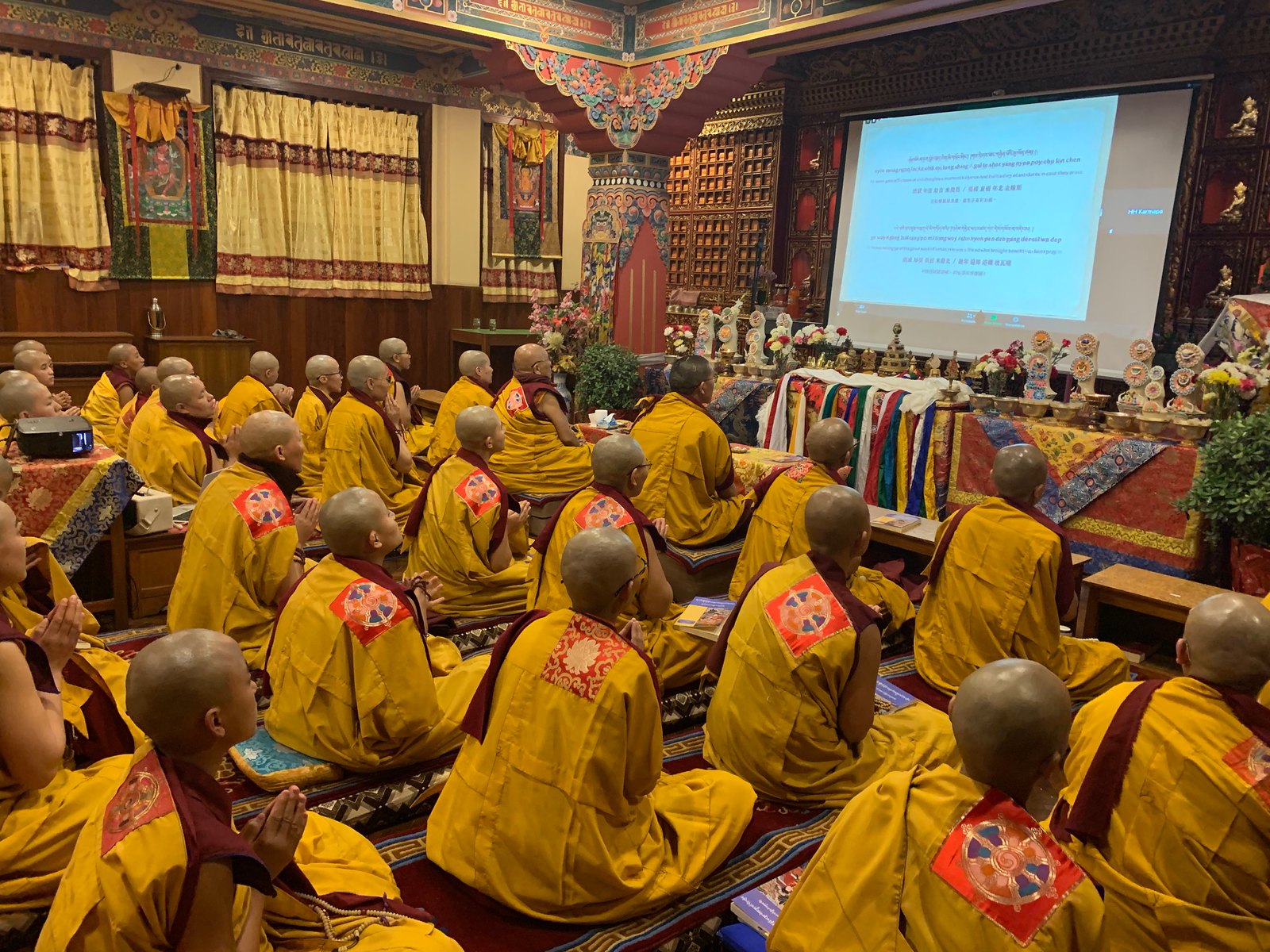
2021.02.24 Day 7: The Blessings of Many Authentic Gurus


Day 2: Liberation Stories – Sources of Faith and Good Deeds

Jacek Rosa 2021 Arya Kshema 02 September 2026

Arya Kshema Spring Dharma Teachings:
17th Gyalwang Karmapa on The Life of the Eighth Karmapa Mikyö Dorje

February 16, 2021

Part 1 – Listening to Liberation Stories and the Importance of Faith

Following the recitation of the opening prayers, on the second day, His Holiness emphasized two important but interrelated topics – how liberation stories reveal the path to practitioners and the crucial necessity of faith.

Regarding liberation stories, His Holiness first contextualized the background on the collected works of the Eighth Karmapa Mikyö Dorje. He explained that the Fifth Shamar Könchok Yenlak compiled the complete catalogue of Mikyö Dorje’s collected works, but a few of Mikyö Dorje’s liberation stories are found elsewhere.

For instance, Sangye Paldrup’s commentary on the Good Deeds says:

…The liberation story prepared by Akhu Atra, the liberation story by the master of siddha Gampo Khenpo Shakya Senge, and the liberation story by Lama Pönyik…

Sangye Paldrup mentions several different stories of Mikyö Dorje’s liberation. Other than the one prepared by Akhu Atra, the other two liberation stories are not found in the collected works.

His Holiness explained the texts to be discussed in this teaching are: The Life of Karmapa Mikyö Dorje Called “Good Deeds” Written by Himself and the Praise “He Searched Thoroughly…”. The Good Deeds is the longest and most complete autobiography of Mikyö Dorje. The edition of the Good Deeds that he is using comes from the first volume of the Collected Works of Mikyö Dorje that has been preserved in the Drepung Nechu Lhakhang library.

His Holiness shared a story about his delight in first encountering the Collected Works of Mikyö Dorje. When he was in Tibet, there were more than one-hundred old Kagyu manuscripts and  texts in the libraries of the Potala, Norbulingka, and Drepung Nechu Lhakhang.The old texts were from the Tse Lhagang Monastery in Kongpo in the same location as the treasury of the Karmapas. According to the Great Fifth Dalai Lama’s autobiography, the texts were brought to Ü when this monastery was destroyed.

Many of these cloth-wrapped texts were still sealed with red stamps and had not been opened and read in 300 years, but Tsurphu Khenpo Loyak carried all these old manuscripts back to Tsurphu Monastery. His Holiness shared his fond memory of the experience,

“I still remember that day very well. I brought a stick of incense down to welcome the texts. It was the first time in my life that I was an incense bearer. We arranged silks on top of a table and placed the books there. At that time, I was next to Lagen Drupnam and he opened up a volume of Mikyö Dorje’s collected works. Mikyö Dorje’s collected works were held together with wooden boards and leather straps. When the leather straps were undone, they fell apart into many pieces because they were so old. When we touched the cloth covering the text, dust clouds billowed up. Looking at it from the outside, you would have thought the text inside had decomposed. Instead, the pages shone. Most of the text was handwritten and we were so delighted to see it; we all gasped ‘Ah!” 

His Holiness animatedly expressed his pure joy when he encountered the collected works of Mikyö Dorje or any of the Karmapas. While at Tsurphu his quarters were right across from the library, so he would always get texts and read them including the collected works of the Thirteenth Karmapa and Fifteenth Karmapa. One story he particularly enjoyed was in the Thirteenth Karmapa’s collected works. In the story called “Dharma Taught to the Little Mouse Drupgyu Tenzin,” a mouse teaches meditation to a vole. The vole was unable to sit cross-legged so they made a meditation belt out of grass so that he could.

Gyalwang Karmapa went on to explain the meaning of the title “Karmapa”, the one who performs activities. He commented that in the word “Karmapa”, karma is from Sanskrit, not Tibetan. When we translate it from Sanskrit into the Tibetan term, las, it means action. Then it includes the nominalizer, pa, signifying the person who performs the action. Many Tibetans do not know that the term ‘karma’ comes from the Sanskrit. So when they write it in Tibetan, they use spellings for other Tibetan terms that sound similar such as ‘star’ (skar ma) or ‘white’ (dkar po) instead of the spelling as transliterated from Sanskrit (karma pa).

Next, His Holiness shared the meaning behind liberation stories. When the Sanskrit term vimoksha is translated into Tibetan, namthar (rnam thar), it means liberation story. Jamgön Kongtrül Lodrö Thaye’s autobiography describes liberation stories classified according to the three types of beings – the greater, middling, and lesser type of individual. For the lesser type of individuals, they achieve liberation from rebirth in the three lower realms due to having pure faith and believing in karma, cause, and effect. Middling individuals achieve liberation from the ocean of samsara through the true wish for emancipation. Greater individuals achieve liberation from both extremes of existence and peace through the altruistic intention to benefit all sentient beings. These liberation stories tell how masters have been liberated from suffering and its causes and then freed other beings from their bonds.

In Acharya Aryaśūrapada’s Jataka Tales, it says:

These fine tales of those with marks of fame,
Teach the path of becoming a sugata.
Those who lack faith will gain faith.
They will be delighted with dharma tales. 

The liberation stories of great beings show us what is the path and what is not the path. Also, those who lack faith will develop faith. In this way, liberation stories are directly related to faith.

His Holiness illustrated the importance of faith through the example of the Buddha’s decision to turn the wheel of Dharma. After the Buddha was enlightened, he did not immediately teach the Dharma. During that time, Brahma came down to the human realm and asked the Buddha to turn the wheel of Dharma. The first time he made this request, the Buddha replied that the Dharma was so profound that ordinary people would be unable to understand it. When Brahma asked him a second time, the Buddha thought to himself, “All buddhas teach Dharma in order to tame all sentient beings and I should do the same.” So, he promised to turn the wheel of Dharma. Then, the Buddha said to Brahma, “Today, I have uncovered the flavour of amrita nectar, all those with faith will be delighted. I shall teach them the true Dharma.”

His Holiness emphasized that “the Buddha said, ‘all those with faith will be delighted’.” Gyalwang Karmapa elaborated:

The Buddha did not say all those who are generous will be delighted, nor did he say that all those who keep discipline will be delighted, nor did he say all those who practice will be delighted, nor did he say that all those who have diligence will be delighted, nor did he say that all those who meditate on prajna will be delighted. He did not say those who have great prajna will be delighted. He only said that those who have faith will be delighted. The reason for this is that the true Dharma is profound and immeasurable. It is inconceivable. So those with great worldly prajna cannot realize it. It can only be realized by the omniscient. So worldly people will not be able to immediately understand the teachings of the Buddha. Therefore, the condition for ordinary people to enter the Dharma is based upon faith. 

His Holiness concluded by describing the interconnection between faith and liberation stories. The main point is that liberation stories reveal the great qualities of liberated beings. Since beginners must rely on faith and devotion, liberation stories show great beings’  qualities such as little desire or attachment to the world, intelligence as scholars, experience and realization as meditators, and how their deeds on behalf of the teachings make a lasting imprint.

Part 2 – The Homage in Good Deeds

For the second part of his teachings, His Holiness directed our attention to the text Good Deeds. Mikyö Dorje’s liberation story recounts thirty-three of his different good deeds. His Holiness rhetorically asked and replied, “What is a good deed? A good deed should be understood as a virtuous act.”

In the sutras, the Buddha taught the three types of harmful deeds and good deeds. Harmful deeds refer to the unvirtuous actions of body and so forth whereas the virtuous actions of the body and so forth are called good deeds.

The three types of good deeds are also called purifiers. For example, all the good deeds of body, purify the body, the good deeds of speech, purify speech, and the good deeds of mind, purify mind. The reason they are called purifiers is that the stains of harmful actions of body, speech, and mind are purified through good deeds.

Sangye Paldrup, a direct disciple of Mikyö Dorje, wrote a meaning commentary on Good Deeds with an outline of three main sections of the text as follows:

The Autobiographical Verses called “The Good Deeds”

  1. Homage and pledge to compose
  2. The nature of the biography
  3. Conclusion

For this teaching, His Holiness covered the first topic. Regarding the first section it is divided into two parts, paying homage to great beings and the pledge to compose, as seen in the verses:

To those with unrivaled compassion—the Three Jewels
And gurus—I pay homage with respect.
Great beings would see nothing wondrous here,
But some childish beings might enjoy these words. 
A few high masters have encouraged me
By saying that it would be meaningful
If I recounted some of my good deeds. 
Since I know best what I experienced, I’ll relate a few.

Among the first of these two parts is paying homage to the great beings; the text states:

To those with unrivaled compassion—the Three Jewels
And gurus—I pay homage with respect.

His Holiness explained the meaning in general terms. Mikyö Dorje is paying homage to the Three Jewels and the gurus. He is prostrating to them. What are these three jewels and who are the gurus to whom he pays homage? The Three Jewels refers to the Buddha as described in the Mahayana – a buddha with the nature of the three kayas. The Dharma means the truth of cessation, freedom from attachment, and the truth of the path which leads to freedom. The Sangha is the irreversible noble beings with the qualities of awareness and liberation. The basis for that is all them, is all glorious gurus.

Gyalwang Karmapa noted, “The homage is extremely important.” Generally in Tibet, all authors begin texts with an homage to the buddhas, bodhisattvas, and gurus. The purpose of this is to prevent any obstacles to writing or completion of the text. As His Holiness explained, Good Deeds begins with prostrations, offerings, and praise because Mikyö Dorje’s greatest aim was to protect all sentient beings from endless suffering now and in future lifetimes. Writing his autobiography depended upon  favorable conditions including the kindness and great compassion of the Three Jewels and the great lineage holders.

As emphasized in the Kadampa oral tradition, no matter what action you do,  you should prostrate and make offerings to the Three Jewels. Prostrating to the Three Jewels and the gurus removes obstacles and helps us accomplish our desired aims. In fact, there is nothing more powerful than having belief in the Three Jewels and the gurus.

His Holiness then turned to the second of these two parts – the pledge to compose. This comprises five different points:

    1. Expression of modesty
    2. How this is for the faithful and receptive
    3. The actual topic
    4. Refuting that this is inappropriate
    5. Dispelling exaggerations and denials

For the expression of modesty, we see the line:

Great beings would see nothing wondrous here,

The meaning of this line is that the great beings are already free from delusion about what should be done or rejected. Great beings would not feel amazement since they have already reached nirvana and omniscience.

The second point of these five is – How this is for the faithful and receptive. This relates to the line:  

But some childish beings might enjoy these words. 

Childish beings refers to the ordinary individual, in particular, those who have a longing for the Mahayana. When they see or hear the story of Mikyö Dorje’s liberation, they might feel faith, develop delight, and train and follow in his example. He is teaching this liberation story specifically for their sake.

The third point is the actual topic. The text states:

If I recounted some of my good deeds.

The meaning is that the author, Mikyö Dorje, will recount several of his good deeds.

The fourth point is refuting that this is inappropriate. The passage states:

A few high masters have encouraged me
By saying that it would be meaningful

His Holiness explained this passage. Here, Mikyö Dorje was neither influenced by the eight worldly dharmas nor is he a charlatan. In fact, the author did not feel that he had to tell this story but his students consistently encouraged him to do so.

The fifth point is dispelling exaggerations and denials. The text reads:

Since I know best what I experienced, I’ll relate a few.

If someone else had written this liberation story, a different author, they might have exaggerated Mikyö Dorje’s qualities. Since his experience of his deeds is only vivid to him, he wrote the text himself.

His Holiness ended the session by elaborating on this. When the students write their guru’s liberation stories, they make too many proclamations and only praise the guru. But when the guru composes his own story, his experience of liberation is clearly recorded, just as seen in the Good Deeds.

Click the photo to view photo album:

2021.02.16 Day 2: Liberation Stories


Day 3: First Deeds of a Nirmanakaya

Jacek Rosa 2021 Arya Kshema 02 September 2026

Arya Kshema Spring Dharma Teachings:

17th Gyalwang Karmapa on The Life of the Eighth Karmapa Mikyö Dorje

February 17, 2021

His Holiness began by offering welcome to the khenpos, teachers, nuns, shedra students, and all others listening to his teaching. 

Aided by appealing graphics, he then began explaining the second of the three main sections of Mikyö Dorje’s autobiographical text, Good Deeds. This section, “The Nature of the Biography,” has two parts:

A. The preliminaries: how to enter the dharma
B. The main part: how he practiced the paths of the three types of individuals

Part A has six subsections:

1. The meaningful deed of a supreme nirmanakaya
2. Abandoning the impediment to dharma, negative friends
3. The favorable condition: following great spiritual friends
4. Abandoning meaningless distractions
5. Giving up on this life because impermanence has taken root in his being
6. Going for refuge to the undeceiving Three Jewels

The second stanza of Good Deeds demonstrates the first point, “the meaningful deed of a supreme nirmanakaya.” 

Once I had gained a human life with leisures and resources,
I dared not squander it pointlessly. With single-minded focus,
I did all I could to practice dharma just as the Buddha taught.
I subjugated forcefully any wrong thought that arose.
I think of this as one of my good deeds. (1)

In this passage, Mikyö Dorje explains how he took on a human body, entered the gate of the Buddha’s teachings, made vows, and performed virtuous deeds to make his life meaningful. This is the first of the thirty-three good deeds given in the text.

His Holiness began illuminating this stanza by explaining a prophecy made by the 7th Karmapa, Chödrak Gyatso, based on his pure vision of gurus, yidams, dakinis, and especially Padmasambhava, who predicted that if he entered strict retreat for three years, he would live to the age of eighty-eight. Intending to follow this guidance, Chödrak Gyatso went to Kongpo and spent a few months in retreat. But the people of Kongpo had a great desire for an audience with the Karmapa, and the monks in the encampment asked him to grant this request because they were running out of food and needed offerings to support themselves. The 7thKarmapa granted their request but said, “Are you going to eat the meat without milking the cow?” He left retreat in 1506, dissolved his nirmanakaya and appeared in sambhogakaya form to a hundred thousand people who gathered to see him. He passed away the next morning with no illness, leaving a testament saying, “I have no birth but will display a birth.” Chödrak Gyatso specified where he would be born and the names of his parents. He left this on his table.

His successor, the Eighth Karmapa Mikyö Dorje, was born in Upper Dokham near the monastic seat of Karma Gön. This was the same region where the 6th Karmapa Tongwa Donden was born. There’s a debate about the identity of the 8th Karmapa’s father. According to Mikyö Dorje’s autobiographical Account of the Past Actions of Mikyö Dorje, his biological father was Ser Jadralwa Jampa Shennyen, but he was raised by Ajam. His mother was named Dongsa Lama Drön. 

Mikyö Dorje’s conception and birth were miraculous. Spheres of light appeared inside his parents’ house, as if the sun was shining inside. He probably entered his mother’s womb at that time, and she had a wondrous dream about a plain filled with beautiful flowers. Inside a majestic tent were splendid offerings, texts, and statues; pieces of white conch shaped like stupas fell like rain. A turquoise-colored mist surrounded the scene. Boys and girls adorned with jewels danced and sang as they circumambulated the tent. The mother put on bone ornaments and also danced while picking up a golden vajra in her hands. Seeing another woman with a white conch, she took it and made a beautiful sound. Everyone heard the conch. There was a throne inside the tent, on which a monk sat. He said that everyone had heard the conch she blew. Ajam had a prayer wheel and began singing the mani melody while others joined in. Then the monk gave the mother a mala made of conch and told her to recite the mani mantra. She woke up to the sound of the mantra. Enveloped with feelings of pleasure, she experienced great joy. In general, parents of the Karmapas are often associated with white conch shells, His Holiness added.

From the time of conception until Mikyö Dorje was born, there were sounds of scriptural recitation around his house. Light surrounded his mother and his home. He also protected her when he was in her womb. When she went to collect wood for a fire, a voice told her there was going to be a great hail storm. She got back inside her house just before the storm began. The baby also chanted OM MANI PADME HUM within her belly. Once his father and mother got into a fight, and he hit her with a frying pan. The child within admonished him not to do that.

During this time, when his father was coming back from the fields, he saw a person with bone ornaments, who gave him a black crown made of rainbow light. Some thought he had seen a ghost, and they did repulsion rituals. Even the neighboring villagers had miraculous dreams during this time.

In 1507, his mother gave birth to Mikyö Dorje without discomfort. He immediately sat up, wiped his face and said, “I’m the Karmapa.” There was a rain of flowers, the scent of incense, and a rainbow-colored column of light that went up from the roof of his house into the sky. Significantly, the Ming Emperor Zhengde was enthroned on the same day in China. He said that he was an emanation of the Karmapa. 

After he was born, Mikyö Dorje said OM MANI PADME HUM and made other holy utterances. Because of that, some people believed that he was the rebirth of Chödrak Gyatso. Many people came to see him in Ngom. At this time, Situ Tashi Paljor visited the area, learned about the baby, and consulted the 7thKarmapa’s prediction letter. Mikyö Dorje’s father confirmed the facts of the letter, except that the names of the parents were not one hundred percent the same. His birth year indicated that there would be an obstacle to his life. Situ Rinpoche gave instructions to overcome these obstacles and told the father that the child might say something significant. In fact, he did say, “E Ma Ho. Do not have any doubt in me. I am called the Karmapa.” Situ Rinpoche sent one of his patrons, Tsokye, who also examined him. Mikyö Dorje said the six-syllable mantra seven times. Another group from a local monastery visited him, and Mikyö Dorje spoke again, happy to see them. As a result, they felt a lot of faith. 

The tulku had tiny teeth, the size of mustard seeds. His father touched them, and that night they disappeared. From that time onward, his tongue was somewhat inflexible, and his speech was a little bit uncomfortable. 

From the time of his birth, Mikyö Dorje told stories about people he knew in previous lives and displayed other miraculous abilities. When he was only seven months old, he was invited to Riwoche Monastery, the major seat of the Taklung Kagyu lineage. The master of Riwoche was Jigten Wangchuk, and he was extremely kind to Mikyö Dorje. He gave him food and clothing and unconditional support during a succession dispute between the Eastern and Western candidates. But Jigten Wangchuk engaged in violent activities. He supported the military, and his faith in Mikyö Dorje did not get stronger. However, Mikyö Dorje had a dream about a house in which Jigten Wangchuk lived. The tulku saw Avalokiteshvara on a lotus seat inside the house. He felt faith in Jigten Wangchuk as if he were Avalokiteshvara. (The Karmapa had this dream much later when he was 31.) 

The early period of the 8th Karmapa’s life was somewhat unsettled. When he was nine months old, Mikyö Dorje was brought to Lhorong Dzong Monastery. Until he was six years old, he was shuttled between Dzongsar, Lhorong and Riwoche Monasteries. 

The last part of His Holiness’s presentation concerned a succession dispute that complicated Mikyö Dorje’s recognition as the 8th Karmapa. He began this topic by noting:

So with the situation of the 16th Karmapa, there are two or three people recognized as the tulku. People think that this is unprecedented, and they can’t get their minds around it. This has actually happened before in history, so we should . . . understand this. 

One difference between now and the time of Mikyö Dorje, however, is that the Karma Garchen [Great Encampment] still existed in Tibet, and it functioned as the main center of the Kagyu lineage. The tulku had to be recognized by the Karma Garchen before he could be enthroned as the Karmapa. Even though it was widely known throughout Kham that Mikyö Dorje was the reincarnation of the 7th Karmapa, he had to be recognized by the Karma Garchen.

The regent of the Karmapa at that time was the Second Gyaltsap Rinpoche, Tulku Tashi Namgyal. A lama named Sönam came to Gyaltsap Rinpoche and told him that the rebirth of the 7th Karmapa had occurred in Ngom. However, there was a lama from Amdo —a crafty fellow, a bit audacious. He had a child, and when this son was born, the parents also experienced auspicious dreams and good omens, so they trained the boy to act like a tulku, and then took him to the Encampment at Kongpo Drak Tsum. Most of those in the Encampment were from Kongpo, so the crafty lama bribed them with beer, good food and other things, to encourage them to support his son. In addition, a student of the 7th Karmapa Chödrak Gyatso verified that the Amdo candidate was the reincarnation of his teacher. Gyaltsap Rinpoche, however, looked into the 7thKarmapa’s testament and was convinced that Mikyö Dorje, was the true Karmapa chungsi, but, as the majority of members in the Encampment supported the tulku from Amdo, he had no choice but to go to Kongpo Drak Tsum to meet the other candidate. When Gyaltsap Rinpoche presented the child a kata, three times the boy inauspiciously gave it back. This was a bad sign. These days, the receiver immediately gives the kata back to the offerer; but in the old days, the offerer would give a kata and then the one being offered the kata would give a different one back. To return the offered kata was a sign of disrespect, as if to say, “I don’t need this.” So Gyaltsap Rinpoche did not feel good about the Amdo candidate from the very beginning.

To resolve the matter, Gyaltsap Rinpoche and the head of the Encampment, Tashi Döndrup, invited the Amdo candidate to Kongpo Tse Lhagang, an extremely important monastery because it functioned as the Kamtsang treasury, where all the treasures of the first six Karmapas were stored. The Amdo tulku was asked to make a short retreat there. When Gyaltsap Rinpoche examined his dreams during this time, all of the regions to the West were black and unpleasant looking, while the ones in the East were filled with light and very beautiful. Likewise, he dreamed of a white lion in the West who could not roar, but in the East there was a grand dragon, and when it roared, the lion in the West immediately turned into a white dog.  

Pawo Tsuglak Trengwa, only nine years old at the time, records a conversation he had at Tuchen monastery with the head discipline master [trimpön] Denma Goshri, who reported that the father of the Western candidate was very cunning. The Amdo lama had even admitted that he had rehearsed his son in certain lines: “It’s very easy to make a tulku. . . the child just needs to know a few sentences to become a tulku.” 

Nevertheless, the majority of people in the Encampment continued to support the Western candidate. They should have been looking after Mikyö Dorje and his parents, providing accommodation, food and all daily necessities, as was the custom, but very few people in the Encampment took any interest in the parents of the real tulku. For that reason, food and clothing became very scarce for Mikyö Dorje’s parents during his early life. They had to live as beggars. The earlier Karmapas were recognized at a very young age, and their needs were always addressed. Mikyö Dorje wasn’t recognized until he was seven. He had illnesses that nearly caused him to die, but his parents didn’t have the resources to do anything about it. It was a very difficult situation. At that time, he thought to himself:

Once you are named as a rebirth or tulku, you can’t do anything for the sake of future lives. You have to spend all your time working for this lifetime. In this lifetime, you don’t even have control over your food and clothing. . . You are caught in the great mire of suffering. . . Let me be considered an ordinary person. If I’m not given the name Karmapa, in the future, I’ll go to a monastery in Ü Tsang in Central Tibet and practice listening and contemplating and meditation in the same way as the great masters of the past did. And in that way, I’ll do whatever I can to restore the teachings that have been lost and to benefit sentient beings.

His Holiness added jovially, “And so he thought about it, and he was happy in a way. I don’t have to be the Karmapa! It’s kind of nice.” 

At that point, some students of the previous Karmapa did a divination using a child as an oracle of Mahakala Bernakchen. A prophesy emerged that Mikyö Dorje would be recognized as the Karmapa by the emperor of China and all the people throughout the world. At the same time, masters with samadhi and clairvoyance also recognized Mikyö Dorje as the true reincarnation. On the contrary,  those who examined the Western candidate could find no reason to affirm his status as the tulku. People from Mikyö Dorje’s birthplace even sent a letter to the Encampment supporting his claim to the title Karmapa, and urging them to enthrone him.  At that point, Gyaltsap Rinpoche felt he was able to invite Mikyö Dorje to the Encampment, and representatives were sent to welcome him. However, the welcome party was hesitant.  Arguing that the contest between the Eastern and Western candidates was still undecided, they decided in advance not to prostrate to him or ask for blessings. The situation was similar to that of the Buddha’s five close disciples when they first met him after his enlightenment. They were unhappy with Shakyamuni and made a rule not to venerate him when they saw him again. But when the Buddha approached, they were so overwhelmed by his magnificence that they prostrated to him without hesitation. Likewise, when the lamas and monks actually met Mikyö Dorje, their perception changed They prostrated and offered katas—everything that they had said they weren’t going to do. He recognized almost all those who had served the previous Karmapa and called them by name.  Overwhelmed by the power of faith, they shed tears and everywhere there was a joyous noise.

On the 1st day of the 1st Month of the Year of the Bird, Mikyö Dorje met Gyaltsap Rinpoche for the first time. Gyaltsap Rinpoche asked many questions designed to determine if the boy was the actual tulku. Mikyö Dorje recognized him and answered his questions with confidence. It was Losar and the Karmapa’s throne had been set up in the shrine room. Mikyö Dorje went directly to it and started to mount the throne, but, because there was still some dispute, everyone was so nervous that they stopped him. Thus, there were many signs that Mikyö Dorje was the true tulku but the monks of the Encampment were still uncertain and couldn’t make up their minds  

The tulku addressed Akhu Atra, a student of the 7th Karmapa, and Jangchup Rinchen, the Secretary of the Encampment: 

None of you teachers and students in the Encampment know how to make a discussion. You don’t know how to make any plans. I’ve shown so many signs that I actually remember past lives. . .  and [there are] so many omens, but none of you understand anything, no matter how many signs I show. . .  How are you actually going to recognize the Karmapa? Will anything good ever come of this? You are incompetent… You must decide the question with your mind.

So, at that time, according to the Tibetan system he was seven years old, but if you count from his birth he was actually less than six years old. Nevertheless, he had such power that he was able to speak in this way.

Still nothing was decided. In the end, members of the Encampment summoned both candidates—the one from the East and the one from the West—in front of a huge crowd, and cross-examined them about the Dharma, about worldly affairs, and tested their ability to recognize people and objects associated with the life of the 7th Karmapa – they showed them two teacups, one of which had belonged to the previous Karmapa. They also acted aggressively towards them in order to test them. The Amdo tulku was only seven by Western counting, and he didn’t know much. He failed the tests and started crying. Not willing to admit defeat, the boy’s father with his henchmen tried to scare the Eastern tulku. But Mikyö Dorje remained unperturbed; he was in fact a little bored. “There’s no point to this,” he thought. So, the supporters of the Eastern candidate presumed they had won. They started celebrating; they held horse races and a sangoffering ritual.

Despite the clear outcome of these tests, the father of the Western candidate still had many of the members of the Encampment under his thumb, and Gyaltsap Rinpoche couldn’t do anything about it. It was a difficult, sad situation. The men from Mikyö Dorje’s homeland were so incensed by the opposition to Mikyö Dorje that they got ready to attack the supporters of the Amdo tulku. They were prepared to kill them. When the supporters of the Western tulku saw the enraged Khampas, they were so afraid that they went to Gyaltsap Rinpoche and told him that he could do what he wanted.

At last, Gyaltsap Rinpoche prayed to the deities to find out who was the real tulku, and he had a visionary dream. Mikyö Dorje came to him in this dream, offended. “You still have doubts about me. . . Do what you are going to do,” he said. Gyaltsap Rinpoche offered him the best cushion, but the tulku didn’t take it and left. A little later, a woman came before Gyaltsap Rinpoche with a huge white conch. She said, “I have blown this conch in every land. . .  But you still aren’t taking care of the conch. So what’s that about?” She left in the direction that the tulku had gone. Then a woman with a wrathful appearance came to him, counseled him not to listen to lies and then went away. After this visionary dream, Gyaltsap Rinpoche developed faith that Mikyö Dorje was the unmistaken successor to the 7th Karmapa.

So finally, on an auspicious day, the Eastern tulku was enthroned and, at that point, everyone felt profound faith. They could not believe that0 they had previously doubted Mikyö Dorje was the authentic Karmapa. Where did the Western tulku go? Mikyö Dorje proclaimed that he was a tulku from Surmang; the boy entered monastic life while his father, the Amdo lama, fled. After that, things didn’t go well for him.

With this, the Karmapa concluded his brief account of the dispute between the Eastern and Western candidates. He ended the session by announcing that in the next teaching, he would speak about the birth places and birth dates of the previous seven Karmapas.


Click the photo to view photo album:

2021.02.17 Day 3: First Deeds of a Nirmanakaya


Day 4: A Historical Examination of the First Eight Karmapa Reincarnations

Jacek Rosa 2021 Arya Kshema 02 September 2026

Arya Kshema Spring Dharma Teachings: 17th Gyalwang Karmapa on 

The Life of the Eighth Karmapa Mikyö Dorje

February 19, 2021

His Holiness opened the teachings by greeting everyone warmly. He then announced that today was Chamgön Vajradhara Tai Situpa’s birthday. He asked the audience to join him in reciting Long Life Prayers for Tai Situ Rinpoche, as written by the previous Drupön Dechen Rinpoche, and pray that Tai Situ Rinpoche accomplish his vast activity just as he wishes.

Researching the lives of the first eight Gyalwang Karmapas

His Holiness has conducted extensive research on the lives of the first eight Gyalwang Karmapa reincarnations, examining and comparing historical texts, documents, and chronologies of the Karma Kamtsang written by past Kagyu masters. In particular, the First Gyaltsap Rinpoche’s biography of the Seventh Karmapa titled The Liberation of Rangjung Kunkhyen Tsokye Dorje Mipham Chökyi Gyalpo, and a manuscript named The Dates of the Incarnations of the Karmapas were used as the bases for the first part of His Holiness’ teaching today. 

From these sources, His Holiness was able to collect biographical information on the first eight Gyalwang Karmapas. This information included the names of their family clans, birthplaces (as they are known today), birthdates, parents’ names, names when young and after ordination, and the dates of their passing. His Holiness presented tables for each Karmapa summarizing the essential information he has uncovered. He then thanked the many dharma friends who assisted him by travelling to the Karmapas’ various birthplaces in China to research old place names and to take pictures of the various regions as they appear now. 

The First Karmapa Dusum Khyenpa: His birthplace clarified

According to the table, His Holiness had made, Dusum Khyenpa was born to Gompa Dorje and Lhatok Sagang in the year of the Male Iron Tiger (1110 CE). He was named Chökyi Drakpa after taking ordination, and he lived until the age of 84 according to the Tibetan way of calculating one’s age.

There had previously been some confusion about the First Karmapa’s birthplace, which His Holiness now clarified. The First Karmapa, Dusum Khyenpa, was born in Raktak (also Ratak, Rathak, and Ratsak) in Tre (also called Trewo, Krewo, and more recently Treho), located in the Kardze district of Kham. Later, the Ninth Karmapa and one or two Shamar Rinpoches were also born in Tre. For this reason, up until the 10th Karmapa, many Kagyu monasteries and teachings flourished in the region of Trewo. However, the Mongol invasion destroyed all but three Kamtsang monasteries and, as a result, as the years passed, fewer and fewer people took an interest in Karma Kagyu history. In addition, the stories of the Karmapas and Shamapas have been mixed up. His Holiness hoped that with today’s explanation, histories would become clearer.

These days, people often say Dusum Khyenpa was born in Bochok; some of his descendants continue to live there, there are many stories related to this, and there are many of Dusum Khyenpa’s artifacts that they can show. In 2010, for the 900th anniversary celebration of Dusum Khyenpa’s birth, his birthplace was listed as Bochok in His Holiness’ book and on the internet. However, His Holiness noted that in written texts, Dusum Khyenpa’s birthplace was said to be Raktak. As it happened, one or two years ago, His Holiness received an old document called the Vajra Splinter Travelogue, written by the Eighth Karmapa Mikyö Dorje’s personal physician and attendant, Gelong Shangkarwa Jikme Ngakgi Gyatso. His Holiness then showed on screen excerpts from the Travelogue, paired with modern photographs of the regions described. Among the descriptions of the various regions through which these attendants passed and among the details of the journey presented in the Travelogue, His Holiness was able to confirm that Dusum Khyenpa’s birthplace was Tre (called Trewo Rangtak in the Travelogue). An examination of another text, the Golden Garland of the Kamtsang, which quotes an autobiography of Karma Pakshi, also indicates that Kamkhyim in Tre was Dusum Khyenpa’s place of birth. His Holiness’ research suggests that Bochok was actually the birthplace of one of the Shamar incarnations, whereas Dusum Khyenpa was, in fact, born in Raktak in Tre. 

The First Karmapa Dusum Khyenpa: Establishing the Three Seats

According to His Holiness, one of Dusum Khyenpa’s most important deeds was founding several monasteries, including the three main monastic seats, and establishing the foundation for the teachings of the Karma Kamtsang. There are several ways in which the three monastic seats have been described and identified. For example, they have been called the Upper, Middle, and Lower seats (a classification scheme based on the monasteries’ geographic location) or the Places of the Three Chakras of Body, Speech, and Mind. 

For today’s teachings, His Holiness used the Sixth Shamar Rinpoche Chökyi Wangchuk’s Guidebook to Kampo Nenang in which he wrote:

Gampopa had students as numerous as stars in the sky, but [Gampopa} said to Dusum Khyenpa, “I have the highest hopes in you, white-haired Khampa”, and he entrusted the teachings of the Karma Kagyu to Dusum Khyenpa. He said to Dusum Khyenpa, “Go to Kampa Gangra in Kham and do retreat there,” and predicted, “Your benefit to beings will spread throughout Kham, Ü, and Tsang.” 

For that reason, Dusum Khyenpa went to Kampo Nenang in Kham, made a retreat, and realized the Dharma Nature. He then nurtured many students and founded the first monastic seat, Kampo Nenang. 

The three principal seats associated with the Karmapas were:

  • Kampo Nenang – the lower seat – the chakra of body (now a Gelug monastery)
  • Karma Gön – the middle seat – the chakra of speech
  • Okmin Tsurphu – the upper seat – the chakra of mind

The Sixth Shamar Rinpoche also wrote of Five Sacred Sites. In addition to the sites of Body, Speech, and Mind, he named Pongri in the east as the site of qualities and Dapba Pangpuk as the site of activity. Subsequent teachers, such as the 13th  Karmapa and Jamgön Kongtrul Lodrö Thaye, had different classification systems. For example, Jamgön Kongtrul Lodrö Thaye’s Nonsectarian Dharma History lists two places of qualities: Pungri in the east and Kamkhyim in Tre, near Dusum Khyenpa’s birthplace; and two sites of activities: Bara and Drama Drushi.

Many famous monasteries were founded by successive Karmapas and their heart sons, but in terms of history, there were three seats and five sacred sites of body, speech, and mind. His Holiness said it is better if we consider these to be the monasteries founded by Dusum Khyenpa. He reminded listeners that Dusum Khyenpa practiced at Karma Nenang, realized the truth of the dharmata, and established a monastery at that site. The people of Karma Nenang monastery became known as the Karma Nenangpas, or the Karma Kamtsang. 

The Second to Seventh Karmapas: Biographical overviews

His Holiness continued by briefly covering the biographical information he had collected about the Second to Seventh Karmapas. Generally, he stated, all incarnations of the Karmapa are the heads of the Karma Kamtsang teachings, and therefore the seats they established are the most sacred. Dusum Khyenpa’s monasteries in particular provide the foundation of Karma Kamtsang’s teachings. Many of these monasteries have now fallen into disrepair. Nevertheless, His Holiness urged listeners to respect them and recognize why those sites are important. 

The Second Karmapa, the mahasiddhi Karma Pakshi (1206-1283), restored Dusum Khyenpa’s three monasteries and preserved and spread the teachings. It was during his time or later that the name “Karma Kagyu” emerged. The year of Karma Pakshi’s birth is uncertain; there are differing accounts, perhaps because there were different traditions of counting years. Consequently, between the passing of the First Karmapa and the birth of the Second, there was a gap of at least ten years but possibly more. His Holiness noted that this is the longest gap between two successive Karmapa incarnations. 

His Holiness continued by presenting information on the Third Karmapa, Rangjung Dorje (1284-1339), who passed away in Xanadu, one of the two capitals of the Mongol Empire. The day after his passing, many people saw Rangjung Dorje’s image in the moon, leading to the tradition of painting the Third Karmapa in a full moon. 

The information on the Fourth to Seventh Karmapas was similarly covered.  

The Eighth Karmapa Mikyö Dorje: Beginning The Praise “He Searched Thoroughly”

The first stanzas in the autobiographical praises the Good Deeds and He Searched Thoroughly are related. His Holiness noted that Mikyö Dorje initially offered  The Praise  “He Searched Thoroughly” to Karma Trinleypa, who felt he did not have the qualities to accept it. Therefore, he offered it back to Mikyö Dorje.

The Praise “He Searched Thoroughly” is taught in terms of nine different points. The first point explains how the Eighth Karmapa first entered the teachings and then brought others to them. The first two stanzas read:

He searched thoroughly for the unerring essence 
Of the teachings of the unrivaled Teacher,

Had the discipline that leads to the true ways,
And practiced the teachings in full—to him I pray.

Pawo Tsuglak Trengwa explained that when Mikyö Dorje entered the teachings of the Buddha, he was not satisfied with merely the names of teachers or with the saying that monasteries and representations of the body, speech, and mind were teachings. Instead, Mikyö Dorje felt compelled to understand the actual meanings of scriptures. Only at that point did he enter the teachings. Afterwards, he was able to introduce the teachings to others. 

His Holiness spoke of the stages by which Mikyö Dorje entered the teachings–  through the Vinaya. Primarily vows of individual liberation, the Vinaya includes novice vows that one may take upon entering the teachings and the bhikshu vows of ordination. His Holiness’ explanation included the vows Mikyö Dorje took from the age of seven to full bhikshu ordination. Additionally, His Holiness talked of the first two Gyaltsap Rinpoches, as the Second Gyaltsap Rinpoche, Tashi Namgyal, conferred lay and novice vows upon Mikyö Dorje.

His Holiness concluded by saying that the teaching would continue on Day Five with the second topic, the difficulties the Eighth Karmapa faced, especially regarding abandoning harmful friends, and how, because Mikyö Dorje did not have much power, he came under the control of attendants and stewards.


Click the photo to view photo album: 2021.02.19 A Historical Examination of the First Eight Karmapa Reincarnations


Day 1: The Black Hat Lama

Jacek Rosa 2021 Arya Kshema 02 September 2026

Arya Kshema Spring Dharma Teachings:

17th Gyalwang Karmapa on The Life of the Eighth Karmapa Mikyö Dorje

February 15, 2021 

In December 2020, the Winter teaching on The Four Dharmas of Gampopa was the focus for the Kagyu Winter Dharma Debate, held annually for the monks’ shedras. This teaching is the Arya Kshema Spring Dharma Gathering directed at the nuns’ shedras, though monks’ shedras, dharma centres and a worldwide audience of laypeople are also watching. 

Seven nunnery shedras are participating: Tilokpur and Palpung Yeshe Rabgyeling in India, Ralang Kyegue Dhagmo Chosling in Sikkim, Karma Samten Ling, Thrangu Tara Abbey and Karma Thekchen Leksheling in Nepal, and Karma Drubdey Palmo Choskyi Dingkhang in Bhutan. Before the webcast commenced, the nunneries made mandala offerings to the 17th Karmapa.  Nuns from Karma Drubdey nunnery provided the backing as His Holiness sang The Praise “He searched thoroughly”  and recited the opening prayers.

Introducing the topic for the month’s teaching, the Gyalwang Karmapa commented on how many scholars within the Kagyu tradition felt a particular affinity for Karmapa Mikyö Dorje:

It is not just that he wrote commentaries on the Middle Way, Prajnaparamita, Vinaya, and Abhidharma. It is also because he used the power of his own diligence at learning and the power of his intelligence to write many complete and unerring explanations of the intent of the sutras and tantras; the assertions of the great texts; the view, meditation and conduct of the Kagyu masters of the past, and so forth.

At one point during the teaching, His Holiness quipped, ‘Today I’m just telling stories all day long!” But, as he had explained earlier, this teaching was not intended to be a history lesson. The Gyalwang Karmapa’s aim was twofold. His first intention was to help us understand the origins of the lineage and appreciate its greatness:

If we think we should uphold, preserve, and spread well the teachings of the Practice Lineage, we need to know what its origins are, how the forefathers initially established the teachings, how later masters upheld them, and in the end, how much hardship and effort they went through in order to spread them… The more we research and study this, the more we can understand what the majesty, the essence, and the true value of this lineage are.

Secondly, we are dharma practitioners and any study needs to be internalised. The real instructions of the great masters of the past were not written down but are evident in the way they lived their lives, their thoughts and activities; the test of authenticity is whether the guru’s thoughts and activities accord with the dharma. These two autobiographies demonstrate how “an ordinary person, an ordinary monk worked hard to make his life be in harmony with the dharma…they are direct instructions from his experience during his lifetime.. profound instructions on real practice”.

Citing a wide range of sources as evidence —Tibetan histories, sacred biographies, Chinese texts, and documents discovered at Dunhuang —His Holiness explored the origins and meaning of the name “Karmapa”, the origins of the Black Crown, and the relationship between the first three lineage holders, Dusum Khyenpa, Karma Pakshi and Rangjung Dorje. He concluded from his research thatDusum Khyenpa was the first bearer of the Black Crown, that Karma Pakshi was the first to be known as Karmapa, and that Rangjung Dorje, the Third Karmapa, was the first to be recognised as a tulku. This is further substantiated by Karmapa Mikyö Dorje who wrote, “the omniscient Rangjung Dorje, was the second to bear the name Karmapa and the third bearer of the Black Crown”.

The Karmapas have become known as the Black Hat Lamas. The Karmapa asserted that the Black Crown tradition definitely originated with Dusum Khyenpa and the first black crown was either made by him or by others under his direction. It was not offered to him by a king, high lama or any other person. Dusum Khyenpa was the first to wear the Black Crown, and his students visualised him wearing a black crown. Karma Pakshi supports this:

Because he [Dusum Khyenpa] was the same in essence as Saraha, as a symbol of the unchanging dharma nature, he wore a crown of black silk with a gold blaze such as had never appeared anywhere before on earth, representing the unrepresentable through co-emergent wisdom mahamudra and through various symbols…

These early crowns were unelaborate and stitched from ordinary material. An example still exists— Karma Pakshi’s crown at Karma Gön.  Further, His Holiness pointed out that the Karmapa’s crown is not black but a very dark blue. There are several explanations for this, one being a connection with Buddha Akshobhya in the Vajra Buddha family in tantric practice. His Holiness quoted another explanation of its symbolism as described by Rangjung Dorje:

Namo guru! I prostrate to the lord gurus.
Dakinis, grant your blessings.
I shall explain in part the qualities
Of this black crown with garuda wings and gold blaze.

The base being slightly dark
Is a symbol of the unchanging dharmakaya.
The sides being square is a symbol
Of the four immeasurables.

Having two garuda wings
Is a symbol of the inseparability of means and prajna.
Having three points is a symbol
Of the three kayas being complete in him.

Having four colours is a symbol
Of accomplishing the four activities.
Being adorned with five silks
Is a symbol of the five families dwelling above the head.

Having the parasol, sun, and moon
Is a sign that the guru is a wish-fulfilling jewel
And always accompanies, never apart.
Having a blaze on the forehead
Is a symbol of knowing the one dharma that liberates all
And understanding everything known to be one.

This crown that has these symbols
Is the rainbow of the great Brahmin.
It was bestowed by the dakinis.
It is the crown of Dusum Khyenpa.
May those with faith and devotion for this crown
Meet glorious Dusum Khyenpa.

The Black Crown itself has changed many times during its history. In the Chinese court, hats indicated status, and the histories and biographies clearly state that the Mongol and Chinese emperors gave crowns to the Karmapas. Karma Thinley mentions two such crowns in the Great Encampment: “one made of Mongolian fabric that the Mongol emperor Timur Khan offered to Rolpay Dorje [Fourth Karmapa], and one called Dzamling Yeshak studded by many jewels given by the Chinese emperor Qing Ha to Lord Tongwa Donden [Sixth Karmapa]”.

Indeed, the Karmapas accumulated a great treasury of gifts and offerings they had received, but many of these treasures were lost at the time of the Tenth Karmapa, Wangchuk Dorje, during the war with Gushri Khan. Even more were lost during the cultural revolution. All that remains is locked away in the treasury at Rumtek Monastery.

In addition to wearing the Black Crown, the Karmapas also perform the Black Crown ceremony, but, as His Holiness acknowledged, its origins are less clear. The histories suggest that it began during the time of the Seventh and Eighth Karmapas, but it is possible that it began earlier. In his biography of Sonam Gyatso [Third Dalai Lama (1543 CE – 1588 CE)], the Great Fifth Dalai Lama recounts how the Karmapa performed a Black Crown ceremony specially for Sonam Gyatso, which had a great effect on the latter.

The format of the ceremony has changed several times. Even during the lifetime of the Sixteenth Karmapa, many small changes were introduced. The main point, however, is that the ceremony was a thongdrol or “liberation on seeing” and its aim was to encourage virtue. Participants were urged to recite ten million mani mantras, to perform life releases, and to keep pure conduct.

Another tradition associated with the Black Crown ceremony, and widespread across Tibetan culture, is reciting the six-syllable mantra [OM MANI PADME HUM], singing it to a melody, and carrying a mani prayer wheel. This tradition of mani recitation originated with Karma Pakshi, whose main yidam deity was Red Chenrezig, Gyalwa Gyatso. Karma Pakshi spread the practice across Tibet.

There seem to have been two different crowns used in the Black Crown ceremonies which can be identified— Meaningful to See and Dzamling Yeshak. These appear to have been more elaborate and jewelled than earlier crowns, but the basic features remained the same. No one is sure which of these the 16th Karmapa wore.

The mani mantra was used by the Karmapas from the time of Karma Pakshi until at least the time of the Fifth Karmapa, Deshin Shekpa, and then it was replaced gradually by “Karmapa Khyenno” meaning “Karmapa! Please watch over me. Please protect me.” However, as His Holiness reminded everyone, the name “Karmapa” means "the one who accomplishes the Buddha's activities” and as such applies to any authentic guru. Whenever we recite “Karmapa Khyenno” we should visualise that we are supplicating all the lineage gurus and spiritual friends not just those in the Karmapa lineage.


Click the photo to view photo album:
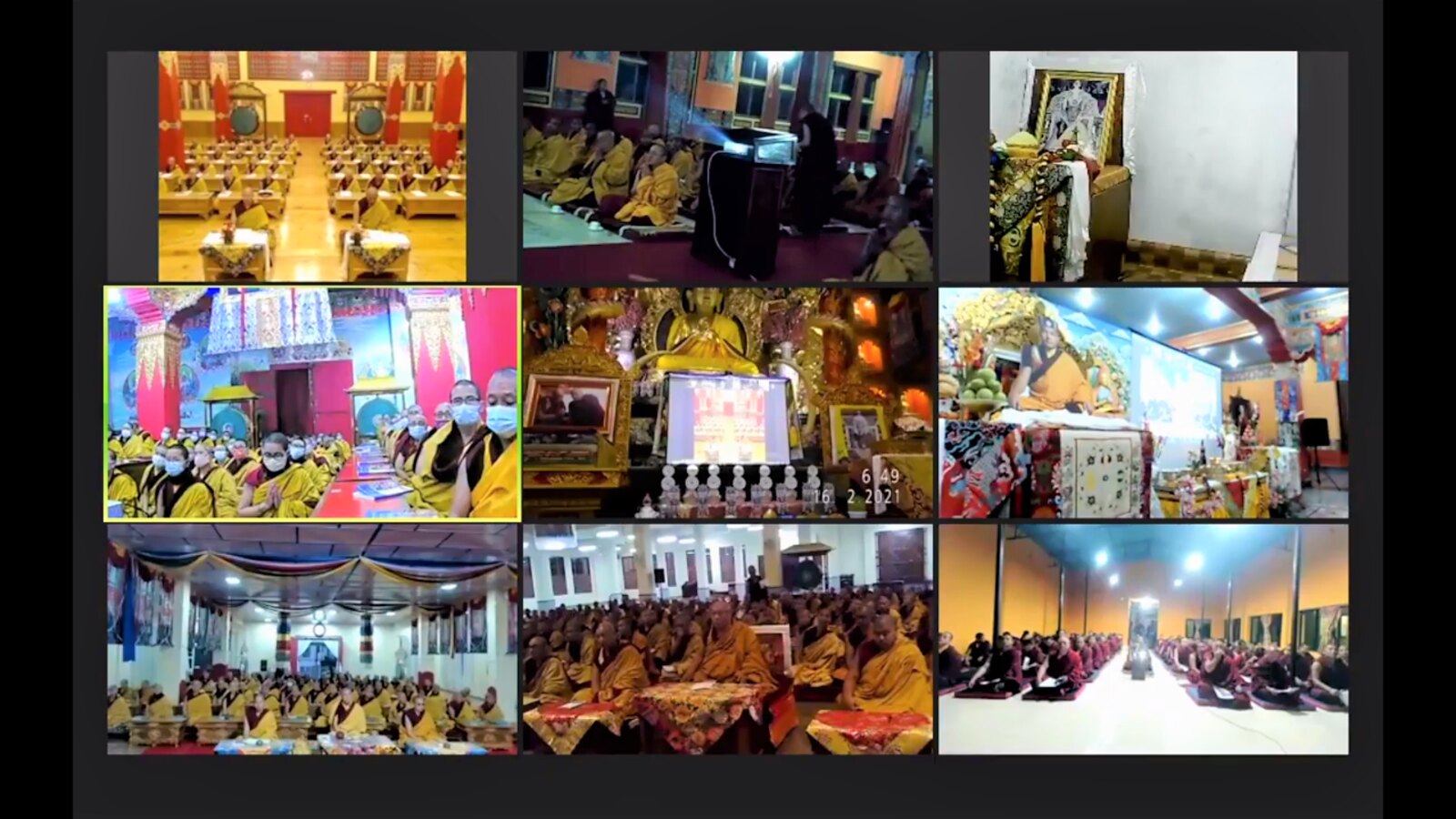
2021.02.15 Day 1: The Black Hat Lama


  1. Spring Dharma Teachings • 15.02 – 14.03 2021

Page 4 of 5

  • 1
  • 2
  • 3
  • 4
  • 5
  • Home