• +228 872 4444
  • +775 872 4444
  • contact@email.com
Arya Kshema Winter Debates
  • Home
Sign In

Day 13: Severing the Stream of Misdeeds

Jacek Rosa 2021 Arya Kshema 02 September 2026

Arya Kshema Spring Dharma Teachings:

Gyalwang Karmapa on The Life of the Eight Karmapa Mikyö Dorje

March 5, 2021

Part 1: Never harming another being

His Holiness continued teaching on Mikyö Dorje’s seventh good deed, as well as introduced the eighth good deed today. 

As you may remember from yesterday, it is said that Mikyö Dorje practiced the paths of three types of individuals: the lesser, the middling, and the greater. His seventh good deed discusses his practice of the first path, that of the lesser individual. The text reads: 

Once I knew that all suffering that occurs is the result
Of my own wrongs, I could not complete in full
Unvirtuous acts with preparation, deed, and aftermath.
I have not completed an unvirtuous act in this life. 
I think of this as one of my good deeds.

For Mikyö Dorje, it was essential to never harm another being as he recognized only suffering would be experienced as a result. According to the Instructions on Training in the Liberation Story of Mikyö Dorje, which explains the meaning of the “Autobiographical Verses of Good Deeds”, beings have been wandering in samsara since beginningless time because they do not know what causes lead to pleasure and what causes lead to suffering. On the other hand, the perfect Buddha told us what we should and should not do. For this reason, in the fifth good deed, Mikyö Dorje spoke about going for refuge to the Three Jewels, the only sources of refuge that can teach the path of giving up misdeeds and practicing virtue.

Although we’ve been taking birth in samsara from beginningless time, our actual nature ultimately is free of birth or arising, staying, and perishing. Unfortunately, we do not know this. As a result, we have many constructions, perceptions, and denials about that nature and our thoughts lead us to wander in samsara.

As we’ve wandered in samsara, we’ve been connected to other beings – as one another’s children, parents, and so forth – innumerable times. We have benefited each other and formed great connections many times before. Therefore, if we harm others rather than benefit them, the fully ripened result will be an experience of terrible suffering. Moreover, the compatible result from harming them will also arise. In other words, not recognizing how other beings have not only harmed but have also helped us throughout beginningless samsara, we inflict harm upon them, and then we experience harm as a result. This is how karma occurs. 

Although we have done many things that will cause suffering in the future, if we had thought deeply about their actual nature first, we would never have dared to do such actions. Thus, we must try to guard this thought “I must never dare to do anything to harm another sentient being” throughout our lifetime, never letting it wane. We must also try to prevent thoughts about harming others from arising.

For those of us who say we have entered the Buddhist teachings—studied karma, cause and effect to understand what we should do and what we should abandon—and say we’re applying the antidotes of mindfulness and awareness, we must be cautious when problems arise. Sometimes, when a problem comes up, we blame the place, the time, or another individual, and claim, “I had no choice but to do that”, “I had no control”, and “it was not my fault”. We forget the needs of next and future lifetimes for the sake of having some minor sensory pleasure in this one and we commit unvirtuous actions. Mikyö Dorje did not act in this way. It was said that he would never do anything contradictory to the teachings even if it meant gaining the pleasures and happiness of the gods in this lifetime. His Holiness compared it with there being poison hidden in delicious food and knowing you would die if you ate it. A sane person would not eat this poisoned food, no matter how hungry or thirsty he or she was. Likewise, no matter what difficulties we encounter, it is not right to give up on the true Dharma. Therefore, Mikyö Dorje was very assiduous in giving up misdeeds and accomplishing virtue.

Part 2: Repairing relationships and restoring harmony 

Mikyö Dorje was not confident that he was a nirmanakaya buddha as some of his followers believed. He thought that he had been given the title “Karmapa” in this lifetime not because he had the necessary qualities of abandonment and realization but because it was a blessing of all the activities of the previous Karmapas and the buddhas. In this way, he viewed his title more like a name, not as an indication of his attainment. Thus, he said, as long as he remained in this present state of aggregates, of full ripening, stricken by birth, old age, sickness, and death, he would protect himself against karma, cause, and effect.

How did Mikyö Dorje practice what he taught? One way was by reducing conflict and sectarianism between different Tibetan Buddhist lineages. Mikyö Dorje concluded that sectarianism could lead to individuals giving up their liberation, bodhisattva, and tantric vows. For example, monks would go off to battle which in turn would lead to destroying representations of the Three Jewels and the taking of each others’ lives. These kinds of heinous acts would completely destroy the Buddhist teachings and the Sangha community. Therefore, Mikyö Dorje warned followers to stay away from such evil actions and avoid desiring the success of one lineage over another. Although one may think s/he is practicing the Dharma, when one divides individuals into factions and subsequently helps one’s own faction and harms another, s/he is actually acting according to her/his own wishes, desires, hatred, and delusion. Mikyö Dorje pointed out that these were actions of attachment and aversion, not actions of the Dharma. 

The Eighth Karmapa understood that attachment to external objects and one’s internal mind, including the attachment to hatred, arrogance and so forth, leads to disharmony, faults, and problems. He therefore decided to leave the eastern region of Tibet, where the Karmapas were popular and powerful,l for Central Tibet, which was ruled by kings who governed by strict laws. Mikyö Dorje’s monks had to follow him as he journeyed to Central Tibet, and they stayed in isolated places as well as in areas where locals had little regard for the Dharma. Mikyö Dorje knew that in such places, he and his monks would receive fewer offerings and less respect. By leaving areas where they had power, sensory pleasures (and therefore attachments, aversion, and disputes) would be fewer. In addition, he created rules to help them live purer livelihoods, where they wouldn’t be able to pretend to adhere to the Vinaya so that they could take offerings. Further, he prohibited meat and alcohol consumption in the Great Encampment.

You may remember from the teaching a few days ago, the Seventh Karmapa established Tupchen monastery in Lhasa and Yangpachen monastery in the north. Some Geluk monks had suspected the Karma Kagyu were trying to deprive them of offerings, and consequently, disharmony between the two lineages arose. Mikyö Dorje attempted to return the monastery to the Lord of Ü, Nedongpa, but Nedongpa rejected the offer. Mikyö Dorje decided to vacate Tupchen monastery – he didn’t even leave one guard there – and allow it to fall into disrepair. Although some Karma Kagyu followers were unhappy that Mikyö Dorje would neglect a monastery founded by the Seventh Karmapa, Mikyö Dorje was trying to restore happiness between the Geluk and the Karma Kagyu lineages. 

His Holiness proceeded to recount several examples of conflicts over rank, titles, and heights of seats, which he said was one main reason for disputes and the breaking of vows. Over the years many protocols surrounding the demonstration of rank and respect have been created, including the giving of khatags (silk ceremonial scarves), formalizing who should prostrate to whom, and calculating the height of cushions or thrones (the higher the status, the higher the seat). Disagreements have occurred over rank, protocol, position, and status, over the external ways in which respect is shown. Mikyö Dorje understood that these conflicts harm the Buddhist teachings so he tried to prevent them from happening. For example, when people would come to compete with him, he would treat them well without putting himself in an especially low position nor elevating the other unnecessarily. Mikyö Dorje would also meet with people even if they didn’t prostrate to or prepare a seat for him. Some criticized him for so doing, saying that all of the Karmapa’s greatness, influence, and mystique had been lost, that “he used to have a position as high in the sky as the sun but now, horribly, he has been brought downwards to earth”. In this way, he wanted to prevent disputes and not harm the Buddhist teachings. 

Ranks, status, seat heights, and privileges occurred after Tibetan lamas connected with Chinese and Mongol Emperors. These Emperors invited Tibetan lamas to their regions, offered them different coloured seals and stamps, and conferred high titles and positions on them. There had previously been no tradition of rank, position, and privilege such as this in Tibet. In the Vinaya, seniority depends on when a person took precepts – those who took precepts at an earlier point in time had more seniority. In the Vajrayana, seniority is in terms of realization. The monks of Central Tibet’s great monasteries would have to stand outside closed gates waiting to claim their seats. Once the gates opened, they would all rush in and whoever got to the front first got to sit there. Only after the connections with Mongol and Chinese emperors were positions, privileges and ranks given. Before then, there was no question of privilege or rank.

There were many ways that Mikyö Dorje tried to prevent the great stream of misdeeds within himself, but he also tried to sever it within others as well. He instructed both monastics and lay people how to give up non-virtue. As written in the Prajnaparamita sutra:

A great irreversible bodhisattva abandons the ten nonvirtues themselves, gets others to abandon them, declares the excellence of abandoning them, and acts accordingly.

Upon seeing him or hearing Mikyö Dorje teach, many people promised to give up killing, stealing, reneging on their oaths, and being deceitful in their business. Others promised to save the lives of sentient beings and animals, free prisoners, or recite 100,000,000 mani mantras. He would get people to promise not to harm temples or representations of the body, speech, and mind of the Buddha. He had people abide by the fasting vows and asked them to become vegetarian. It was primarily during the Black Crown ceremony that people made these promises. By advising monastics and laypeople alike to give up misdeeds and practice virtue, in the short term he blocked the ways for them to be reborn in the lower realms and opened the gate to higher realms, ultimately bringing them to Buddhahood. This is an example of a great being. If we believe this as true, feeling deeply towards those who brought many to abandon misdeeds and practice virtue, it will bring us much benefit. Trying to be fashionable, trying to get high rank and position, and criticizing great beings are not good; we should avoid these behaviours as much as possible.

Part 3: The Eighth Good Deed – Practicing the path of the middling individual and removing the harmful view of the self 

Unless we fully cross the ocean of birth and death, 
Nowhere in the three realms are pleasures and riches permanent.
I wondered, when will I liberate forever
All beings throughout space from the three realms of samsara?
I think of this as one of my good deeds. 

Mikyö Dorje’s eighth good deed was how he practiced the path of the middling individual. This relates to how having a view of the self and having afflictions in our own being are harmful. In the path of the lesser individual, avoiding harming other sentient beings is the most important. That is the path of karma, cause, and effect. However, not inflicting harm on beings in the short term does not mean they are liberated from harm altogether. This is because in the being’s own continuum, there are karma and the afflictions which are the basis of causing harm. There are also an infinite number of other sentient beings with whom they have a karmic connection, who may harm them. 

If we refrain from creating any bad karma, then even if all sentient beings gathered together to harm us, they wouldn’t be able to. If we do not perform the actions that lead to rebirth in samsara, no other being can throw us into it or cast us into lower realms. What harms us ultimately is the view of the self and the afflictions within us. The afflictions generate our motivations and the actual actions we do, the karma, are our misdeeds. There is no greater or more fundamental harm than that. 

Up until now, we haven’t seen the view of the self and the afflictions as being our enemy or the cause of harm. We actually think of ego-clinging in particular as being our advisor. These thoughts of cherishing ourselves have resulted in the accumulation of many misdeeds and nonvirtues. Even with the destruction of the Earth at the end of an aeon either by fire or by water, all sentient beings and all possessions will be destroyed, but the continuum of beings cannot be stopped. To stop the sequence of being reborn in samsara, we need to train in the methods and prajna that can free us from karma and the afflictions. 

Method is practicing doing what we should do and avoiding doing what we shouldn’t, according to the Four Truths. This includes identifying karma, viewing suffering as being an illness, seeing the Truth of Origin as the cause, knowing the Four Noble Truths and so forth. This is taught in the Three Vehicles and in the sutras and tantras. Practicing them is indispensable. Moreover, we need to have an actual feeling or experience rather than relying on a mere understanding. For example, we should see the afflictions within our being as poisonous snakes. Then we must generate this intention, the diligence, and a strong feeling that we need to get away from them. Mikyö Dorje would tell people that unless we completely eliminate the pernicious illness of the view of the self, the liberation of being freed from the lower realms or achieving samsaric pleasures are not enough. 

Mikyö Dorje worried deeply about those without enough food or clothing or those in desperate situations just as though it were happening to himself. Even if they experienced some temporary improvement, he would still worry. He would think “they are freed of their hardship for the time being but does this count as real liberation?” He knew that until they were liberated completely, they would have to experience endless suffering in samsara. However, although he feared the sufferings of samsara for himself and couldn’t bear the thought of the suffering of others, he knew he could help sentient beings. He said the way to free ourselves from suffering is to study and practice what the Buddha taught. The method was practicing the Four Truths and the prajna was realizing the two types of selflessness. He worked hard to habituate himself to this, and he told others to practice the Four Noble Truths in this way. 

His Holiness cautioned against practicing the Dharma to gain happiness in this lifetime alone. He noted that if some people don’t have a good house or have many family problems, they say they “lack merit”. They think that practicing the Dharma is to bring happiness and to be free of suffering in this lifetime and they practice with this intention. They go to lamas who tell them there’s no real problem, that everything that arises is the display of dharmakaya. The lamas advise them to rest within confused appearances as they are without being distracted and say everything will work out. “Just sit there”, the lamas tell their students. But many people aren’t satisfied with this response. So they try to listen to, meditate on, and contemplate the Dharma, but they do so to gain happiness in this lifetime. This is pointless. Mikyö Dorje would never do such actions himself, His Holiness stated. We listen to, meditate on, and contemplate the Dharma to attain liberation and the state of buddhahood, not to gain temporary pleasures in this lifetime.

This is a brief description of how Mikyö Dorje practiced the path of the middling individual. The rest of the text is about how he practiced the third path, that of the great individual.

Part 4: Mikyö Dorje on vegetarianism

For the rest of today’s teaching, His Holiness wanted to further explain Mikyö Dorje’s reasons for not eating meat. In large monasteries at that time, many animals would be killed. Similarly, sometimes people wanted to give good food to lamas and their entourage and so a lot of meat would be offered. Mikyö Dorje saw that this caused many difficulties so wherever he went, he would very skillfully get others to give up eating meat. 

First, by prohibiting meat consumption, Mikyö Dorje was returning to earlier traditions of previous Karmapas who did not allow meat or alcohol to be brought into the Great Encampment. Second, when Mikyö Dorje was first put on the throne of the Karmapa when he was young, he did not have much freedom or control. All the power was in the hands of the Encampment’s leaders and one of their wives. At that time, all of the animals that were offered to the Encampment were killed and their flesh was eaten. 

When Mikyö Dorje was young, people would approach him saying they needed to have Ganachakras with meat and alcohol. Mikyö Dorje felt this didn’t work at all. Those in the Encampment were no longer respecting the Encampment’s earlier traditions, eating meat without any restraint and drinking alcohol. Once Mikyö Dorje gained some control and influence, he made a strict rule prohibiting eating meat and drinking alcohol. 

He not only restricted eating meat in the Great Encampment, but he promoted vegetarianism to all Tibetans. In Mikyö Dorje’s commentary on the Vinaya, The Orbit of the Sun, he said even when we do the Gutor, the Mahakala ritual at the end of the year, we should not include meat in those offerings. In the index of his collected works, his advice to Tibetans was that it is inappropriate to eat the meat of defenseless animals. 

In the next session, His Holiness would like to teach about the Great Encampment, which is intimately related to Mikyö Dorje’s activities and life story. Once we understand how and why it was first formed, it may provide insight into the Eighth Karmapa’s intentions and actions. Yet, as there is no Great Encampment now, it is difficult for us to form a mental image of what it was, what it was like, and how it flourished. However, teaching on the Great Encampment will be challenging for His Holiness because small bits of information about it are scattered across many different texts. His Holiness then ended today’s teachings with dedication prayers. 


Click the photo to view photo album:
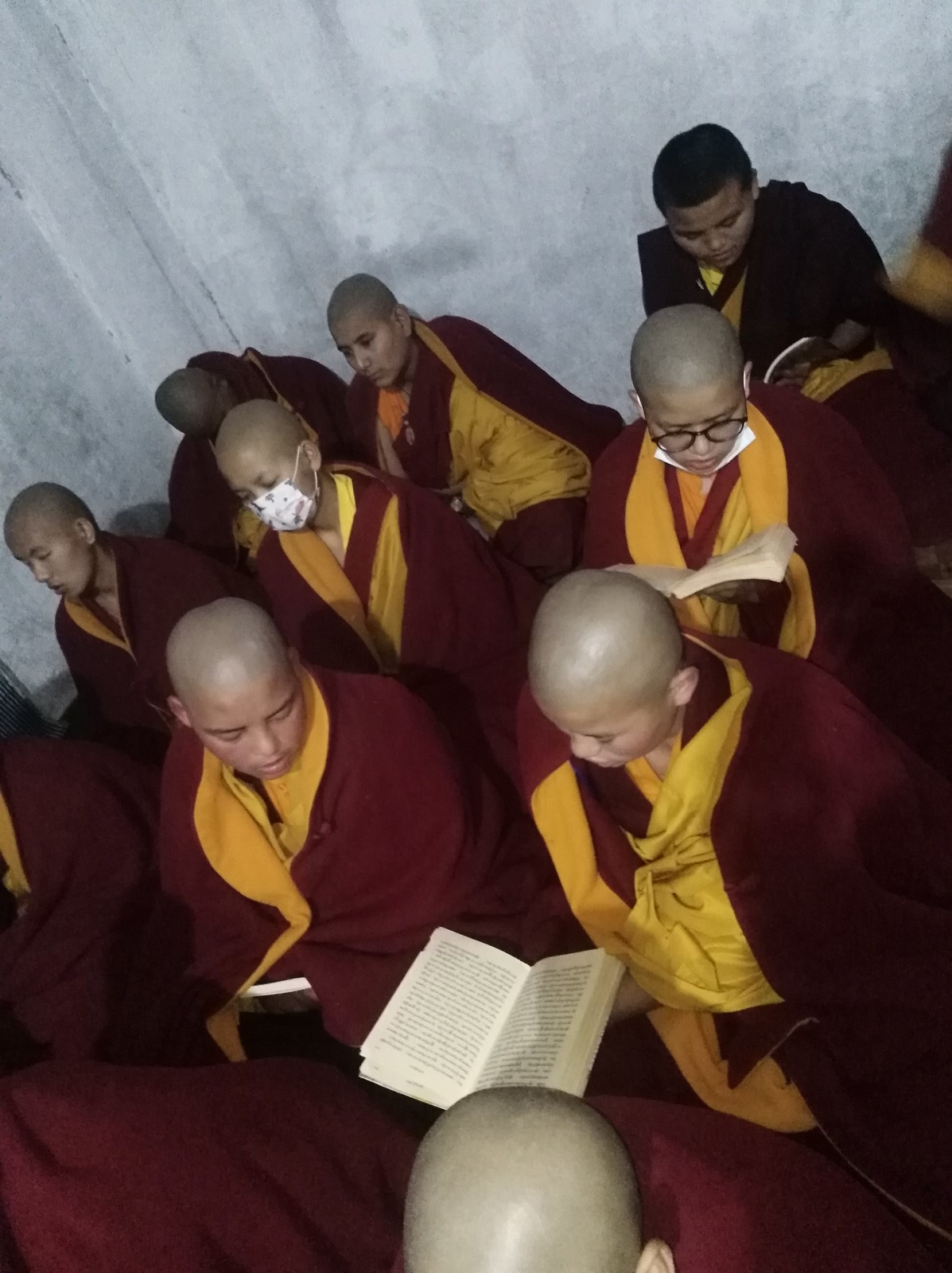
2021.03.05 Day 13: Severing the Stream of Misdeeds


Day 14: The Great Encampment during the Life of the 4th Karmapa Rölpai Dorje

Jacek Rosa 2021 Arya Kshema 02 September 2026

Arya Kshema Spring Dharma Teachings:

17th Gyalwang Karmapa on The Life of the Eighth Karmapa Mikyö Dorje

March 8, 2021

Following his greeting and offering prayers, His Holiness explained the main topic, giving a brief introduction to the Great Encampment, or Garchen, as it relates to Karmapa Mikyö Dorje’s liberation story. In particular, His Holiness, noted he would focus on the historical and contextual background of the encampment this week and speak about the regulations of the encampment later on. 

What do we mean when we say Great Encampment?

His Holiness elaborated on the meaning of the Tibetan word, gar (sgar), referring to sites or camps with many tents. His Holiness clarified that when people would travel from region to region, they would set up and stay in tents made from woven yak hair or fabric. These encampments may be specific to special occasions such as an army encampment, mak gar, a ‘merchant encampment’, tsong gar, and a ‘Dharma encampment’, chös gar. Early on, gar specifically referred to a camp with many tents, and later also meant a group of houses. 

When we talk about a gar chen, great encampment, we add the extra word, chen or ’great’, and it refers to either the large size of the encampment or that it will well-known. Later this was called the Karme Garchen. The reason for this is the direct relationship between the Great Encampment and the Karmapa. Another term of reference was Garpa Yabse, or the “Master and Disciples of the Encampment,” but this was probably a term from other lineages referring to the Karma Kamtsang.

The Karme Garchen in contemporary terms is akin to a company that performed Mikyö Dorje’s work. Mikyö Dorje in this metaphor is like the CEO or company chairman. The Garchen functioned as the headquarters for the Karmapa. A labrang refers to a higher lama’s residence or the organization of people who support him. In contrast, the Garchen was directly connected with the Karmapa and functioned as an administration for organizing the Karma Kagyu overall. 

Establishing When the Garchen Began

His Holiness explained that there are not any clear sources on the origin of the encampment other than Karma Trinelypa’s Questions and Answers: The Brief Meaning of Liberation Stories. If we extrapolate from Karma Trinleypa’s text, it is primarily during the time of the Fourth Karmapa Rölpai Dorje that the encampment became larger in size, its organization became more regulated, and it formally became a true Garchen. For instance, it does not seem likely that the Great Encampment began during the time of the First to Third Karmapas. The First Karmapa, Düsum Khyenpa, was an ordinary monk who did not become well-known until the end of his life; and, early on, he primarily practiced in mountain retreats and traveled with only three or four students. The Second Karmapa, Karma Pakshi, and the Third Karmapa, Rangjung Dorje, both travelled to teach the Mongolian or Yuan emperors. Karma Pakshi lived a very yogic lifestyle; and Rangjung Dorje spent his time writing treatises and doing isolated meditation retreats. 

Since Karma Trinleypa wrote about the Fourth Karmapa, Rölpai Dorje, in his Questions and Answers: The Brief Meaning of Liberation Stories, we know that the Fourth Karmapa was very assiduous in his practice of the Vinaya. From this time, the encampment became more organized and more impressive. Moreover, Karma Trinleypa was a student of the Seventh Karmapa when the Garchen was at its peak. His Holiness concluded that we can rely on Karma Trinleypa’s words as a solid basis for understanding the early origins of the Great Encampment.

The modern scholar, Dunkar Lobsang Trinley, says that the actual organized encampment developed during the time of the Seventh Karmapa, Chödrak Gyatso, but His Holiness came to the conclusion that this was because it was during the time of the Seventh Karmapa that the Great Encampment became most significant. His Holiness encouraged us to read more of this history in the The Water Crystal of the Moon.

His Holiness guided us through his close research into the origins of the Garchen. According to the great scholar, Thubten Phuntsok, when the Fourth Karmapa returned to Tibet from China, many of the faithful monastics and lay people could not bear to be apart from their guru. For this reason, they followed him to Tsurphu and set up a camp near his residence. They spent their time practicing and striving in accord with their abilities. And, this is, in fact, the origin of the Dharma encampment. 

While His Holiness noted the history may be inconclusive, based on Karma Trinleypa’s text, there was clearly an earlier Great Encampment in formation. Kunpang Kunga Lodrö and Karma Könchok Shönnu’s works also provide clear evidence as both mention encampments during the time of Rölpai Dorje.

Summarizing the Important Points of the 4th Karmapa Rölpai Dorje’s Life 

His Birth: Since the histories show how the Great Encampment began with the Fourth Karmapa, His Holiness summarized the key points of Rölpai Dorje’s life. He began with the passing of the Third Karmapa, Rangjung Dorje. Rangjung Dorje passed away in the Mongol emperor’s palace in the Yuan Dynasty capitol, Xanadu. Prior to his death, Rangjung Dorje predicted he would be reborn in the eastern region of Kongpo. This is near Rölpai Dorje’s birthplace in Namdzong in Gochen Pangkar in Ngö, these days known as Alanka, Jiagong, Bianba, and Chengdu. 

Rölpai Dorje’s father was Sönam Döndrup and his mother was Dzomsa Tsöndru. Of the Dong Minyak clan, he was born in the Male Iron Dragon year (1340) on the eighth day of the 3rd month and he passed away at the age of 44. Tokden Gönpo Gyaltsen recognized Rölpai Dorje as Rangjung Dorje’s reincarnation. His main three gurus were Gyalwa Yungtönpa, Tokden Gönpo Gyaltsen, and Tokden Dargyalwa. He took full ordination from Döndrup Pal, the Khenchen from Gendun Gang, and his ordination name was, Dzamling Chökyi Drakpa. When we see the name, Dzamling Chökyi Drakpa, we know this is Rölpai Dorje.

Rölpai Dorje, known for his strict adherence to Vinaya, encouraged his attendants to keep pure discipline. His Holiness gave examples of how they all upheld virtuous discipline by eating only the three white foods – milk, sugar, butter, and so forth. Also, if they saw anyone with meat or bones, they would criticize them. 

His Lucid Dreams: His Holiness then described Rölpai Dorje’s ability to emanate in his dreams; he had such great power over lucid dreaming. At night, for instance, Rölpai Dorje would leave many texts open around him before he went to sleep and while he slept, he would emanate many bodies. When he woke up, he would know what was said in each of the texts. As Rölpai Dorje stated, “The way I have lucid dreaming, is no different from the way illusionists create different illusions.”  According to Karma Trinleypa, Rölpai Dorje had a strong innate knowledge so even though he did not have to study much, he still studied. Among all the Karmapas prior to the Eighth Karmapa, Mikyö Dorje, Rölpai Dorje understood Validity and the Middle Way. He was also a skilled poet. While Karmapa Rangjung Dorje wrote the famous One Hundred Jataka Tales, one of the most beautiful texts, it was Karmapa Rölpai Dorje who wrote the best poetry. He also had many amazing students like Shamar Khachö Wangpo. 

The Jowo Gandhola

Through a series of slides and detailed stories, His Holiness explained one of the main images, the Jowo Gandhola, central to the Karma Kamtsang. The story begins in the Fire Monkey Year (1356) when the 14th emperor of the Yuan Dynasty, the Mongol Toghon Temür (1320-1370, reigned 1333-1370) and his son, the Crown Prince Ayushiridara (1339-1378, reigned 1370-1378), sent great offerings and an invitation to Rölpai Dorje. In the 5th month of 1358, Rölpai Dorje, left Tsurphu at the age of 19 and travelled along the northern route, stopping in Karme and Lhateng monasteries along the way. 

In the Dharma history A Feast for Scholars, it explains that around this time, five yogis came from India and told Rölpai Dorje that they were going to Wutai Mountain in China. They gave him an image carved from the Bodhi tree by Nagarjuna called the Jowo Gandhola. From that time, the Jowo Gandhola image became the primary representation for Rölpai Dorje who made prostrations, offerings, and circumambulated the image four sessions a day. This made a strong impression on his entourage and inspired them to practice virtue. 

His Holiness displayed a slide of a thangka of Rölpai Dorje from the Kagyu lineage thangkas kept at Palpung Monastery. His Holiness directed our attention to the corner of the thangka where he pointed out the five Indian yogis offering the Gandhola. The reason the image is called Gandhola, His Holiness explained, is that in India, temples where the Buddha stayed are called Gandhakuṭi or Gandhālaya. Gandhola is a corruption of those terms. In Tibetan, it would be called “the fragrant temple”. The Gandhola became the primary shrine for the successive Karmapas. When they would take their novice vows or full ordination, they would take their vows in its presence.  For example, if we look at the liberation story of the Seventh Karmapa, written by Goshri Paljor, he writes: 

The supreme support for the meditation of the successive incarnations of the Bearer of the Black Crown, the emanations of the Sixth Buddha Lion’s Roar, is called the Jowo Gandhola. 

In the presence of the unrivaled image, a clear carving of a thousand buddhas in the amazing material of bodhi wood, a wondrous supreme Gandha temple, the hair of the great being who was our guide was cut. 

Thus, the Seventh Karmapa had his hair cut and took his novice vows in front of this shrine. The tradition of making offerings, large and small, began at the time of the Seventh Karmapa. 

His Holiness animatedly explained an exciting aspect of his research. He said, “One good thing that happened was that a few days ago I received, A Catalogue of the Gandhola, the Supreme Image of the Great Encampment by Shamar Könchok Yenlak. Here it says, the main sacred object of the encampment has seven excellent qualities: material, image, maker, origin, power, activity, and blessings.” Unfortunately, the pages describing the maker and the origin are missing.

The Karmapa detailed these qualities according to the text:

  1. The excellent material is that is made from wood of the Bodhi Tree in Bodhgaya. 
  2. The excellent image is the depiction of the Mahabodhi statue and Gandhola temple built around it by Emperor Ashoka, and how the statue can be seen through the door. 
  3. The third excellence is the maker.
  4. The fourth excellence is the origin.
  5. The excellent power is that wherever this image was brought, the ground would tremble, lightning would flash, and all fires, floods, poisons, weapons, illness, hunger, conflict and so forth would be pacified and not occur.
  6. The excellent activity is that since the Karmapa, embodiment of the activity of all buddhas prostrated and made offerings to it, it was brought to many locations in India, Tibet, and Mongolia benefiting beings. 
  7. The excellent blessings are that, just as it is said in the Prajnaparamita sutras, beings who enter the area around the Vajra Seat will not be harmed except as a full ripening of karma. Since this image was made of wood from the Bodhi Tree, it had the same blessings as the sacred place of Bodhgaya. Also doing front and self-visualizations in the presence of this image had stronger and faster blessings than meditating on other yidam deities. 

However, the Gandhola  seems to disappear from the records after the time of the 10th Karmapa, when Mongol Güshi Khan destroyed the Great Encampment. However, Rinchen Palsang, private secretary to the 16th Karmapa, recorded that the regional Tibetan government took it while the 16th Karmapa was in Tibet. 

His Holiness noted, however, that the 1976 publication by Nik Douglas and Meryl White, entitled, Karmapa:The Black Hat Lama of Tibet, includes pictures of some of the sacred objects that the 16th Karmapa brought with him when he fled Tibet. This book includes interviews with the 16th Karmapa and his heart sons in Sikkim as well as an image of the Buddha made by Nagarjuna. Below the image, the text states:

The statue of Lord Buddha, showing miraculous events of his life. This is one of two which were presented to Karmapa Rolpai Dorje by five Indian Holy Men, whom he met on the way to China. This statue was made by Siddha Nagarjuna, out of a metal-like material which was recovered from the magical lake of the serpent kind (Nagas). It is preserved at the new Rumtek monastery, Sikkim.

His Holiness noted that he thinks this image must be the Gandhola, but even in the catalogues and oral histories from Tsurphu Monastery, there is no mention of this being the Gandhola at all. Maybe there is a story behind this, His Holiness explained, because as the main sacred object of the Great Encampment, they were worried someone might seize it. For this reason, they downplayed it and did not use the name Gandhola. His Holiness hopes that if anyone knows more history, they can offer some explanation. 

Rölpai Dorje Spreads the Dharma during his Travels

After this, Rölpai Dorje continued travelling east. He came to a place called Machuy Ling, in present day Amdo region. There, Rölpai Dorje taught the Dharma. The following summer, at the base of the throne where he had taught, a flower grew. This flower had never been seen previously. It had one stalk and eight branches. Each branch had eight flowers with a red corona and yellow center. It was a really strange flower. Anyone who saw or heard of it thought it was really strange. At this time, one monk, Geshe Kyuru Tönpa, said this flower was really amazing. Thinking that this flower would help people develop faith, he either drew an image or took a pressing. He distributed these widely throughout the region and anyone who saw the picture was said to have developed faith. 

When Rölpai Dorje went to the border area between China and Tibet, even though there were unresolved conflicts, he resolved all the disputes and everyone promised not to fight for twenty-five years.

The Emperor had sent a message expressing distress if Rölpai Dorje were not to come to see him. So, the Karmapa went to Lintao monastery founded by Drogön Chögyal Pakpa where he met Khenpo Palden of Lintao. The Mongol Emperor had also invited Sakya Pandita who built Trulpay De. Rölpai Dorje also went to Minyak where he taught the Dharma to many people of different nationalities through Mongol, Uighur, and Chinese translators. 

While he was traveling, he caught a cold. He told his attendant, Guogong Rinchen Pal, that he would cure his illness through a lucid dream and instructed him not to wake him. Later, when he awoke, he explained how he was completely cured:

In my dream, I went to the Potala palace where I saw red Chenrezig who was holding a vase of amrita nectar. He gave that to me and after I drank it, I had this experience of bliss, clarity and non-thought, and my cold was cured. 

In the Year of the Rat, in 1360 in the 12th month, Karmapa Rölpai Dorje arrived in the Yuan capital of Daidu (Khanbaliq, near Beijing). He stayed at a place called the Blue Temple, and bestowed many empowerments on the Emperor and the Crown Prince including: Vajrayogini, the Six Yogas of Naropa, and Mahamudra. He also gave the Crown Prince the additional empowerments of Gyalwa Gyatso, the 100 Jataka Tales, and the Root Commentary on the Sublime Continuum, the Root Commentary on the Sutras, the Root Commentary on the Kalachakra, and related Indian texts. Over two calendar years he instructed other members of the royal family, great ministers, monastics, and an communities of Mongolians, Uighurs, the Koreans. 

Then one day, Karmapa Rölpai Dorje told Guogong Rinchen Pal, that the political situation of the Yuan Dynasty was unstable, the Emperor would not live much longer, and, even if they continued to stay, there was nothing they could do to prevent  bad situations from occurring. For this reason, he made a request to return to Tibet but permission was not given. One time, when the Karmapa made the request, the Crown Prince shed tears and said, “Precious Guru, please stay and hold us with compassion.” This was the first time that someone from the Yuan dynasty shed tears for the Karmapa. Then two ministers, Ma O Jang Ching Sang and She Ra Muan Ching Sang, came to the Karmapa, prostrated, and said, “Since the time you have arrived, all the epidemics have stopped and the Crown Prince has had a son.” This was during the last days of the Yuan dynasty, so there were many conflicts in many regions, but all the conflicts had subsided temporarily and the region had become more prosperous while Karmapa Rölpai Dorje was there. The Emperor and Crown Prince both requested him to stay, with tears in their eyes. He became known as the ‘Auspicious Guru who Brings Good Crops’. They also requested that he engage in political activities, but Rölpai Dorje replied:

I have provided many services and supplicated the Three Jewels on behalf of the Emperor and Crown Prince. I do not have any need for decrees or ranks related to political affairs nor do I have any skills related to that. Monks should go wherever it is best for the sake of teachings and for sentient beings. If a monk stays in any one country and gets attached, that is not good. A good practitioner is one who is not attached to any country. 

The ministers recorded these words. Since he requested so earnestly, the Karmapa was allowed to return to Tibet, and they gave him horses and supplies for traveling back to Ütsang. 

Karmapa Rölpai Dorje’s Non-sectarianism and Miraculous Deeds

Karmapa Rölpai Dorje’s life story also illustrated his generosity and involvement across Tibetan schools. He requested the title of Guoshi for Khenpo Palden Chok of Lintao,  Drogön Chögyal Pakpa’s monastery. He resolved the situation of the First Lord of Pakdru, Jangchup Gyaltsen. According to Karma Trinleypa,  Jangchup Gyaltsen had been slandered by someone from Tibet  and this had created difficulties between him and the Yuan emperor. Rölpai Dorje cleared up the matter and requested that the Emperor give Jangchup Gyaltsen the title Tai Situ. When the Pakdru had taken power in Tibet, the position of the Sakya had declined, but Karmapa Rölpai Dorje made a Dharma connection with Sakya Lama Dampa Sönam Gyaltsen and received teachings from him, which raised the status of the Sakyas.  

Similarly, fifty years before Karmapa Rölpai Dorje’s birth,  there had been a rebellion in Ü-Tsang led by the Drikung, and many people were killed. This caused a great feud between the Sakyas and Drikung. Karmapa Rölpai Dorje, however, mended the relationship between the two schools, and helped rebuild the Drikung monasteries. Likewise, he made requests for the Emperor to benefit all of the great monasteries and lamas of Tibet, irrespective of their tradition. 

When Karmapa Rölpai Dorje was staying in Gansu province, many people came to see him.  Some of them came by horse or camel. Karmapa Rölpai Dorje did his prayers every morning and in between eating his meals, he gave blessings and empowerments continuously for nineteen days without a break or any difficulty.  At that time he received offerings and an invitation from the Mongol king, Tologh Temur, but he did not go.

His Holiness then related a miraculous story of how Rölpai Dorje ended an epidemic, recorded by his attendant, Guogong Rinchen Pal. Rinchen Pal was privy to many secret things but, when he began to write them down, the Karmapa explained this was not a good idea; people might not believe them. And if they did not believe them, they might lose faith.  However,  Guogong Rinchen Pal thought these stories might be beneficial to sentient beings if he shared them, and that is the reason that we have them still, His Holiness explained.

At that time, while staying in the area of Gansu province, there was a large epidemic and many people died. Guogong Rinchen Pal was concerned for their safety so he said to the Karmapa, “There is great danger; what do we do?” The Karmapa said, “I will have a lucid dream tonight and see if I can do something about it. Do not wake me up.” After Rölpai Dorje finished his meditation and prayers, he went to sleep. At that time, Guogong Rinchen Pal stayed awake and watched him. Just before sunrise, a clapping and booming resounded on the roof. Immediately, Rölpai Dorje woke up. He asked Guogong Rinchen Pal, “Did anything happen above the house?” Guogong Rinchen Pal said, “I thought the house was about to collapse.” Then the Karmapa said, “Now the epidemic will not come and spread to this region.” And, Guogong Rinchen Pal, asked, “How is that? What did you do to end the epidemic?” Rölpai Dorje explained to Guogong Rinchen Pal that there were many monsters and an especially frenzied goddess in his dream. Due to this, Rölpai Dorje emanated as a large garuda bird and covered the entirety of Gansu Province. In this dream, he swallowed all of the monsters and goddesses with the fire in his stomach, he burnt them to ashes, and then defecated them all. Since he was in the form of a garuda, he landed on top of the building. This was a mental emanation, Rölpai Dorje explained, so it was strange there were sounds outside because there was no form. Following this, the epidemic died down in Gansu and everyone regained their health. 

While we was staying in Gansu, he received horses, oxen, silver, and other countless offerings, which he sent to Ütsang, where they were distributed to all the monasteries, irrespective of the tradition to which they belonged.  This tradition of making offerings to the monks of all the monasteries lasted until the time of the 10th Karmapa. It demonstrates how the Fourth Karmapa was free from bias or sectarianism; he paid respects and made offerings to all monasteries. 

As Rölpai Dorje continued on his journey to Tibet, he came to the Tsongkha region in Amdo and met a very young Tsonghkapa. Rölpai Dorje gave him the novice ordination vows and the name Kunga Nyingpo. The Fourth Karmapa also predicted that Tsongkhapa would need to go to Ütsang. Later, when Tsongkhapa did go to Ütsang, he became like a second Buddha for the teachings in Tibet. 

The Silk Thangka the Size of a Mountain

Rölpai Dorje went visiting many areas such as the monastery known as ‘The Bowl of Cream,’ near the mountain retreat called, Pal Tsotra. While Rölpai Dorje was there, a wealthy patron, the Lady Puṇyadharī, had a dream. In her dream, she was told to build an image of the Buddha equal to the size of a mountain to fulfill the intention of the great Minyak Prince Ratna, who had died. So, she requested Rölpai Dorje to make this thangka. Rölpai Dorje responded, “If you want to make something the size of a mountain, you have to go to the mountain.” Many doubted and shook their heads confounded by the idea that anyone could make an image as big a mountain. Karmapa Rölpai Dorje smiled and instructed, “You need to make a large applique image of the Buddha and sew it all together.” 

Then, all the gurus, lords, and craftspeople came together to make a mountain-sized applique of the Buddha. He diminished their confusion and instructed everyone to find fist-sized, soft, and round stones from the river. In the oral history, Dharma History A Feast for Scholars, it records Rölpai Dorje riding a horse as he instructed the craftspeople to place the white rocks in the horses’ hoofprints. He rode round and round. People put a rock in every hoofprint until they had a design of the Buddha. Then Rölpai Dorje instructed them to mark the specific size and proportions. In this way, he created the entire design for the thangka. The Karmapa gave her 1900 sang of silver towards the cost of the silk, and the thangka was made by 500 tailors.

His Holiness gestured from ear to ear to explain exactly the extent of this image’s size which he described as “From the right ear to the left ear, it was 11 arm spans so it was basically the size of 11 people.” It had an image of the Buddha sitting cross-legged with Manjushri on his right and Maitreya on his left. When Rölpai Dorje consecrated the thangka, many auspicious signs such as rainbows and so forth emerged. 

To help us understand the actual extent and beautiful detail of this image, His Holiness showed a slide of his own illustration of this mountain-sized thangka regally hanging from the mountain peak. His Holiness explained that the thangka must have been comparable in size with the Statue of Liberty in New York City. It was incredibly huge. 

Afterward, they offered the thangka to Rölpai Dorje who brought it back to Tibet. In Dharma History A Feast for Scholars, the Buddha image was separated into 32 packages and 8 additional packages for the side panels. In the liberation story by Karma Könshön, it says, transporting it required just under 70 dzos, a yak-cattle hybrid, to carry the thangka. Once it arrived in Tibet, of the two side panels, one was given to the Pakdru and one was given to the Drikung Monastery. The main Buddha image was kept at Shokha Monastery in Kongpo, but later it was damaged in a fire. All the different sections were divided up. There were five panels missing, but they were remade at Tse Lhagang. The upper part of the body was in Tse Lhakhang. This was then later kept in one location. This great silk thangka is one of the first appliques of the Buddha. Where is this great silk thangka now? Unfortunately, it no longer exists — Gushi Khan’s army tore it apart and burned it. Since it was a really important artefact and sacred Buddhist image, His Holiness drew it to give us an idea of what it was like. 

The End of Rölpai Dorje’s Auspicious Life

Later, Rölpai Dorje went to the area of the Dunhuang caves where there were 3700 temples at that time. Among them, some had been built by Mongol Emperors, some by Chinese Emperors and some by the Tibetan King Tri Ralpachen. When Rölpai Dorje stayed in this region, many people came to give him offerings. There were eternal lamps to be burned day and night and to restore the temples. This shows his connection there. He also went through the areas of Amdo and  Kham and returned to  Kongpo, to the sacred spot of Tsari. He opened it up and, from then on it became a place of pilgrimage and retreat. He also went on pilgrimage to other sacred spots in Kongpo. 

He then travelled to Nachopa. As there would be a shortage of firewood, the Karmapa instructed them to bring cypress wood. His Holiness explained that the Third Karmapa’s Rangjung Dorje’s remains had been cremated with sandalwood in Mongolia, but there was no sandalwood in Tibet, so they used cypress instead. They went to a beautiful grass covered mountain on Nachopa and set up the encampment. It was said, if a pure bhikshu were to be cremated in that place, the Chinese armies would not come to Tibet.   

At the age of 44, in the Water Pig year, on the 3rd day of 7th month, Rolpai Dorje began to feel unwell. There were many signs such as earthquakes, rainbows, and rains of flowers and so forth. On the 15th day, he made fifty-two circumambulations and prayers, then passed away.  A rock and stone stupa was built in celebration of his auspicious life, and, according to Tsuglak Trenwa, animals would circumambulate that stupa.

In Conclusion

His Holiness wrapped up the teachings with a brief story about Rölpai Dorje’s attendant and foremost student, Guogong Rinchen Pal. It is said that when the Third Karmapa, Rangjung Dorje was staying near Tsurphu monastery, there were many children playing and gathering livestock dung. A dog escaped and the children were very afraid so they ran in all directions. There was one child who did not flee. Instead, with a basket for carrying the dung and a rope, he tricked the dog into running around the basket. Everyone thought, “This is a clever child.” Rangjung Dorje witnessed this and said, “Please give that child to me.” The parents offered the child to Rangjung Dorje, and he predicted that the boy would have great influence. He was Guogong Rinchen Pal; from the Chinese to Mongolian princes to Tibetan leaders, all called him the “Great Master” and would not call him Rinchen Pal. He left the greatest imprint on the teachings. While his dates are uncertain, his life stretched from the end of Rangjung Dorje’s life through his time receiving many teachings from Rölpai Dorje. His Holiness shared that infromation for his teaching had come primarily from another student of Rölpai Dorje’s, Karma Könshön, who studied at the first Tibetan shedra, Sangphu. 

His Holiness then summarized that the life of Rölpai Dorje is central for understanding the background information on the Great Encampment, the Garchen. During his lifetime, the Gandhola was the primary sacred object. Also, the primary rule of the encampment prohibited drinking and meat. Having concluded this rich and detailed background information, His Holiness mentioned that he will elaborate more on the regulations of the Great Encampment in the subsequent teachings. 


Click the photo to view photo album:

2021.03.08 Day 14: The Great Encampment during the Life of the 4th Karmapa Rölpai Dorje


Day 15: Rousing Bodhichitta and the Sacred Gandhola

Jacek Rosa 2021 Arya Kshema 02 September 2026

Arya Kshema Spring Dharma Teachings:

17th Gyalwang Karmapa on The Life of the Eighth Karmapa Mikyö Dorje

March 10, 2021

Practices of the Greater Individual

To begin, the Gyalwang Karmapa spoke about the section of the autobiographical Good Deeds that describes how Mikyö Dorje practiced the path of the greater individual. This section has three different sub-topics: 

a) The intention: rousing bodhichitta
b) Taking adversity as the path in post meditation
c) How he trained in the precepts of the two types of bodhichitta 

The first sub-topic concerns the ninth stanza of Good Deeds:

All beings, without distinction, are the same as my parents.
It is illogical to group them into factions of friend and foe.
With uncontrived love for beings in intolerable states,
I thought, when can I bring them the benefit of true enlightenment?
I think of this as one of my good deeds.

The fifth stanza of He Searched Thoroughly has a similar meaning. The topic is “transcendent generosity, lovingkindness and so forth—and transcendent diligence of nonattachment and so forth,” according to the 5th Shamar Rinpoche. The verse reads:

His mind never free from love and pangs of compassion,
His wish for emancipation was utterly pure.
He always despaired of suffering and its causes
And pondered impermanence—to him I pray.

His Holiness noted that he had already discussed this in regard to the preliminaries of entering the Dharma, but it is also relevant to the practices of the greater individual, so he explained it again in the present context. 

In the Instruction for Training in the Liberation Story, Mikyö Dorje advised his students to discard the afflictions and realize selflessness. We should try as hard as we can to do this. Limitless sentient beings are obscured by the afflictions, and many are quite far from perfect buddhahood, the highest happiness. For that reason, it is important that all sentient beings achieve buddhahood. It doesn’t help much if only a few do so. To achieve this state, we should have compassion for sentient beings who have no guide—even for the arhats who have passed into nirvana [a state of peace which transcends suffering] but who have not yet achieved complete enlightenment [buddhahood]. We need to give up the arhat’s desire for peace, and it goes without saying that we also need to abandon the desire for the richness and bounty of this life. If we have the true wish to achieve buddhahood, we would have no desire to be famous, wealthy, etc. We would not have even the slightest hope for this. 

For this reason, when we see some lamas becoming wealthy and famous, we aren’t envious of them. If we have no wish for these things, there is no possibility of envy. These days, many say that they have no wish for existence nor peace, but in their hearts, they are worried about how successful other lineages are. They have real pangs over this. They think only about what to do to make “our” teachings spread and how to harm the other teachings. This is their primary practice and is completely contradictory to the ways of the bodhisattva. We shouldn’t be satisfied with just a few sentient beings achieving buddhahood. We have to devote ourselves to helping everyone achieve realization and feel unbearable compassion for all beings. Then, arousing bodhichitta is not just words but genuine practice.

The Gandhola: Its Shape, Design and History

Next His Holiness returned to the topic of the sacred Gandhola. Last time, he talked about its origins, and today he described how it appeared, its shape and design, and what happened to it after the destruction of the Great Encampment. Surprisingly—since it was given to the 4th Karmapa—the namthar  written by the direct disciples of Rölpe Dorje, such as Karma Könshön, Tsurphu Kunpangpa, and Shamar Könchok Tenlak, do not mention it. Nor does it appear in the Red Annals by Tsalpa, which were probably written in the year the 4th Karmapa went to China. The 7th Karmapa’s namthar, written by Goshri Paljor Döndrup, is the first to refer to it. Goshri wrote: “the supreme support for the meditation of the successive incarnations of the Bearer of the Black Crown, the emanations of the Sixth Buddha Lion’s Roar, is called the Jowo Gandhola.” The question arises: why was it not written about earlier? His Holiness surmised that this relates to how the Gandhola came into Rölpe Dorje’s possession. 

The Karmapa recently received two copies of an old manuscript by Shamar Könchok Yenlak, and the two handwritten versions of this text do mention the Gandhola. But they are disappointing because in both versions, the scribes omitted a page describing who made it and how it came into the Karmapa’s possession.  However, the History of Karma Monasteries,written by Karmay Khenchen Rinchen Dargye, clearly indicates how the Gandhola came to the Karmapa. 

At the time, Karma Pakshi’s nephew, and then his lineal descendants, oversaw the running of Karma Gön. Many in this line carried the title Situ. At the time the Gandhola appeared, Situ Ārlapa was the overseer of Karma Gön. When Rölpe Dorje arrived at Karma Gön on his way to China, he taught the monks the Six Yogas of Naropa, so the place was filled with retreatants doing these practices. Situ Ārlapa went to practice in closed retreat at a place near the monastery. While he was away, seven Indian archaryas came to Karma Gön wanting to see the Karma Guru [the Karmapa]. But Rölpe Dorje had already gone to China. So they asked to meet Situ Ārlapa, but he was in retreat. The attendant said he would go ask the guru, but they replied that they would depart to find the Karmapa in China. They left a box with the attendant and asked him to entrust it to his guru until they returned. The attendant gave it to Situ Ārlapa, and he instructed the attendant to go and find the archayas. But they had disappeared without a trace. In fact, the Indians weren’t really acharyas; they were emanations of the Karmapa, and they never returned. These emanations had gone to the Tau Shel Cave and opened up a sacred treasury there. They removed the Gandhola and brought it to Karma Gön, where it sat in a box on a shrine until Rölpe Dorje came back. He asked about the box, and it was opened. The Gandhola was inside with a letter describing its history. Rölpe Dorje made offerings, and it then became the Gandhola sacred object.

All this information is in the text by Karma Khenchen Rinchen Dargye. In a previous teaching, the Karmapa showed a lineage thangka from Palpung Monastery in which five acharyas offer the Gandhola to Rölpe Dorje. But the histories reveal that the Gandhola wasn’t directly offered to Rölpe Dorje; it was entrusted to Situ Ārlapa, and the box wasn’t opened until the 4thKarmapa returned from China. Perhaps this is why the liberation stories written by Rölpe Dorje’s direct disciples don’t describe the incident. Karma Khenchen Rinchen Dargye’s source material was probably the 5th Shamar Könchok Yenlak’s Catalogue of the Gandhola or some other old manuscript. Another account is in the Golden Garland of Kagyu Biographies, which says, “Seven emanated acharyas offered the Gandhola to Situ Āryapa or Tsultrim Gyaltsen, the son of Adü, who had taken responsibility for Karma Gön.” These two accounts fit together well.

Another topic is the shape or design of the Gandhola. The Palpung thangka shows the offering in the shape of the Mahabodhi Temple in Bodhgaya. Based on this picture, His Holiness initially thought that the Gandhola must be the same shape as the temple. But the liberation story of the 9th Karmapa refers to it as the Jowo Gandhola. Jowo is an honorific or affectionate term for the Buddha, the one who offers refuge, and this appellation recalls the famous Jowo Shakyamuni statues in Lhasa. This name indicates that the sacred object is a representation of the Buddha sitting inside a temple. Gandhālaya, or “Temples with a Pure Fragrance,” are places where the Buddha stayed. Furthermore, Goshri Paljor Döndrup’s namthar of the 7th Karmapa states that the image is made of wood from the Bodhi tree and depicts the Buddha inside a temple. Images of the deeds of the Buddha surround the main figure. The descriptions in this source conform to the photograph of the sculpture in the Rumtek treasury shown previously. The deeds of the Buddha appear on both sides of this work, but we only see a few indications of the Mahabodhi temple surrounding the figure. His Holiness concluded that the Gandhola’s shape is as described in the texts, not necessarily resembling what is shown in the thangka.

When the Mongol Güshi Khan destroyed the Great Encampment during the time of the 10th Karmapa, where did this object end up? After the battle, Güshi Khan and the 5th Dalai Lama’s steward Sönam Rabten went together to the Black Treasury at Tse Lhangang in Kongpo. This treasury housed all of the Karmapas’ sacred objects, which were originally gathered at Tsurphu Monastery; later the 6thKarmapa transferred the treasury to Tse Lhangang. (This was probably very much like the treasury that still exists at Todaiji Temple in Nara, Japan. Made in the 8th century, the famous Shōsōin Treasury retains its many precious artifacts, including those from the Tang Dynasty.) Güshi Khan and Sönam Rabten raided the Black Treasury and seized many objects, such as the statues of the sixteen arhats made of aloe wood, which were brought to Drepung Monastery where they can still be seen today. Some statues fell into the Brahmaputra River and were lost. 

Many people were concerned about the Gandhola, which was the main object of veneration at the Encampment, but by a stroke of good fortune, it survived. Situ Chökyi Jungne wrote in his autobiography that when he gave lay and precept vows to the 8th Shamar Palchen Chökyi Döndrup in Kargyema’s back room at Tsurphu, the object was present—but he did not mention the name Gandhola. It appears that at this point, people were secretive about it. In the 15th Karmapa’s time, Kartok Situ Chökyi Gyatso went to Tsurphu and wrote about three precious sculptures. The first mentioned was “made of wood of the Bodhi Tree by Nagarjuna with the buddhas of the three times above and the Seven Buddhas below and two wrathful deities. This was offered to Rölpe Dorje by acharyas, who were emanations of the Four-Armed Mahakala.” This description of the Gandhola corresponds to the references mentioned earlier.Furthermore, although Kartok Situ wrote that Nagarjuna made the two other objects, he only mentioned Rölpe Dorje in regard to the first item; he did not say that about the other two sculptures. Since the Gandhola was offered to the 4th Karmapa, we can probably say that the first object is the one he received. But at this point, we only have one photograph that may correspond to the Gandhola. If someday we can open the treasury at Rumtek, we will be able to identify definitively all the items described by Kartok Situ. 

Unlike the other great lamas who fled Tibet during the Chinese invasion, the 16th Karmapa—through his omniscience—was able to bring many sacred objects with him to Sikkim. Based on the photograph that His Holiness showed earlier, it seems that the Gandholais among these objects housed in the Black Treasury at Rumtek. The collection was catalogued at that time, and His Holiness said that he plans to keep researching this topic and would appreciate help, guidance and inspiration from anyone who has knowledge of it.

The Gandhola Offering Ceremony and the Kagyu Monlams

Next, His Holiness established that he would not be able to explain everything about the Great Encampment in this year’s teaching; instead, he will cover four important topics. He has already spoken about the Gandhola, and will next talk about the Gandhola offering ceremonies associated with the Garchen Monlam. In coming teachings, he will discuss the rules about not eating meat and drinking alcohol in the Encampment, and the Karma Gadri style of painting. Other topics associated with the Encampment—its regulations, how it increased in size, how it traveled from one place to another, the learning associated with it—will be addressed next year.

The Karmapa then spoke of the Gandhola Offering Ceremony or the Gandhola Viewing Ceremony. This was a public presentation of the Gandhola and other representations of body, speech and mind, along with elaborate offerings. At that time, the Gyalwang Karmapa or one of the heart sons like Shamar Rinpoche would explain the objects to the members of the audience, and this viewing and listening constituted the Gandhola Offering Ceremony. It’s difficult to say exactly when this ceremony began, but it is described in the namthars of the 7th Karmapa. Pawo Tsuglak Trengwa, in his Feast for Scholars, wrote that Chödrak Gyatso composed the Twenty Branch Monlam, and using this liturgy, turned the wheel of Dharma during the four festivals of the Buddha, especially during the Festival of Miracles held on the 1st to the 15th day of the first Tibetan month.  All of the Encampment’s many sacred objects were arranged surrounded by offerings made from precious substances, jewels, crystals of various colors, turquoise, silver, jade and gogushi (blue turquoise)—and displayed for public viewing.

In Tibet at that time, even kings and wealthy people had never seen or heard of such a display. The offerings increased each day. Chödrak Gyatso would sit on a thin mat and prostrate to them. Later, in Lhasa and Kharu Teng in Ü-Tsang, they would make a big temple out of a sky blue tent—the size of a house of a hundred pillars—with a fabric fence around it, and canopies, vestibules, and a spire adorned with golden birds and dragons. Inside the huge tent, they placed the Gandhola in the center, surrounded by many other sacred objects—such as a statue of the Buddha consecrated by Shakyamuni himself and the meditation support of Atisha. But the main object was the Gandhola. Above it, parasols made entirely of pearls given by the Ming Emperor to Karmapa Deshin Shekpa were arranged in a thirteen-part column, each on top of the next. The size of the seventh parasol was two-and-a-half arm spans, so the lower ones had to be even larger. There were cushions and victory banners made of pearls as well. Even the lord of Ü-Tsang, Dönyö Dorje, was amazed at this. He felt that he had arrived in the world of the gods. Mentang Jangyangpa, who had written about the Menri style of painting and was very skilled at art, thought he was dreaming. He asked, “Have we arrived in the palace of Vaishravana?” All were astounded by what they saw.

There were two different forms of the Gandhola Offering Ceremony—extensive and shorter. The elaborate version included the statues of the sixteen arhats offered to the Karmapa by the Ming Emperor. The pearl canopies were installed even when the Encampment was traveling. At the main monasteries, the ceremony was equally elaborate, extensive and beautiful. Even the stewards did not know the full extent of the sacred objects and offerings. Only the Karmapa with his clairvoyance could keep all of the objects in mind. In order to conduct the ceremonies, organizers had to carry the objects from place to place, packed in boxes. At the time of the 7th Karmapa, the offerings associated with the Gandhola alone required 32 boxes. There was a smaller number at the time of Mikyö Dorje, only sixteen boxes; later there were only six or seven.

To give an idea of what the arrangement looked like, His Holiness showed a drawing he had made that reconstructed the GandholaOffering altar. It showed the Gandhola in the center, with the thirteen parasols above. Representations of body, speech and mind sat on the surrounding shelves, while gold and silver offering vessels adorned with jade, pearls and so forth were on the the lower level. 

Although it’s not known precisely when it began, the Gandhola Offering Ceremony was one of the activities of the Garchen Monlamduring the time of the 7th Karmapa. Goshri Paljor Döndrup wrote that when the Karmapa went to Kongpo, in a place called Lingchi in the town of Sapur, Chödrak Gyatso established the offerings for anniversaries of the Kagyu masters and for other festivals at that time. Monlams were held during the four festivals of the Buddha—Festival of Miracles; Birth, Enlightenment, and Parinirvana; Turning the Wheel of Dharma; and Festival of the Descent from Heaven. They would begin these annual celebrations on the 15th day of the 9th month, during the Festival of the Descent from Heaven. The most elaborate of these events happened during the Festival of Miracles. From the 1st to the 15th day of the first month, they would hold the Encampment Losar. In the morning there would be the Monlam, and in the afternoon, they held dramatic performances and various amusements. Goshri wrote that the Monlams were instituted first; later they added elaborate performances. For example, from the time that Chödrak Gyatso first went to Dawa Tang in Otang, the Festivals of the Buddha always included a Monlam in the morning. In the afternoon, they staged enactments of the mahasiddhas of India and Tibet, the emperors of China, Tibet and Mongolia, Indra and the four great kings, and so forth. During that time, people had visions of the buddhas and bodhisattvas. There were amazing signs and omens, such as rains of flowers and vultures circling the sky in a region where no vultures had previously been. 

The Twenty-Branch Monlam written by the 7th Karmapa is the basis of the liturgy for the contemporary Kagyu Monlam. His Holiness consulted an old manuscript of the Monlam text, but a page was missing. To fill in, he used a Kamtsang prayerbook that included this missing part. So these two texts are the sources for the prayers that we recite at the Kagyu Monlam today.

In Chödrak Gyatso’s time, they performed the same Great Monlam that is in our Kamtsang prayer books, and also the Prayers of the Deceased and Living, written by the 1st Karmapa Dusum Khyenpa. The 7th Karmapa would read the Prayers for the Deceased, and everyone would listen to the dedications. In the afternoon, they staged performances of the Jataka Tales and the mahasiddhas of Tibet and India. People would watch the performances and also gaze on the Karmapa, who normally just sat in meditative equipoise without speaking. He held no worldly conversations and gave few Dharma discourses, but even then, he wouldn’t say much. Every three, five or seven days, he held very short audiences. Mostly, he stayed in meditation retreat. People didn’t even see him when he traveled. Those who lived in the Encampment also didn’t often have access to him. But during these festivals, he sat there for the whole time. It was a rare opportunity to see the Karmapa. 

The 8th Karmapa Mikyö Dorje stopped the performances during the Losar celebrations. In the previous era, the performances benefited beings, but later in the region of Kongpo, people came merely to see a spectacle. Attendees would get together, men and women met and became lovers, and they killed many animals. A previous non-Buddhist king in Kongpo had performed animal sacrifices, and even though Rangjung Dorje later stopped these practices, meat eating continued in this region. So Mikyö Dorje gave up the performance tradition because it increased non-virtue; only the Monlams were held. People from outlying lands would engage in some contests and games, but the Monlams no longer included other performances. Also the 8th Karmapa reduced the number of Monlams, only holding them during the Festival of Miracles. (The first to hold a Festival of Miracles was probably Lord Tsongkhapa in Lhasa. His Holiness will speak of this later if he has time.) 

During the time of the 9th Karmapa Wangchuk Dorje, the Festival of Miracles would conclude on the full moon day with Sangha members conducting a Golden or Monlam Procession. A biography of Wangchuk Dorje recounts that beginning in the Female Wood Pig year (1575), during the Losar Monlam, participants carried images of the Buddha on an alms round, accompanied by monks in the costumes of the sixteen arhats, and along with them, there was a procession of the Sangha. So this was an auspicious ceremony to conclude the Monlam. The Garchen Monlam probably ceased with the 10th Karmapa Chöying Dorje, but the tradition of the Sangha procession on the full moon day continued into the time of the 16th Karmapa. Situ Rinpoche described in the catalogue of the sacred objects of Tibet that people wearing costumes of the Buddha, Shariputra, and Maudgalyayana would make a procession around Tsurphu monastery. The participants made various offerings to each shrine, prostrated, and received khatags. They would recite the Praise to the Buddha’s Twelve Deeds and Prostrations and Offerings to the Sixteen Arhats. Older lamas from Tsurphu told His Holiness that the sixteen Karmapas were also represented in the procession. This brings us to the Kagyu Monlam in our time.

The Monlam Today

The previous Kalu Rinpoche planted the seed for the present Kagyu Monlam, and Kyabje Vajradhara Bokar Rinpoche continued the tradition of a yearly prayer festival in Bodhgaya. After His Holiness arrived in India, he thought that this Monlam tradition was great, but when he saw the old texts, he wanted to improve and increase it—especially in accord with the way it was done during the time of the previous Karmapas. Initially the present day Monlam included a lot of Vajrayana rituals, and many people who came to visit the Mahabodhi Temple might be confused by those words. When they heard references to eating meat and drinking blood, they might wonder, “What are they saying?” So when His Holiness took over the responsibility, he changed it a little bit. But his main aim was that after Bokar Rinpoche’s passing, he would fulfill his predecessors’s aspirations for the Monlam.

Bokar Rinpoche passed away so suddenly that His Holiness couldn’t believe it; Kyabje Tenga Rinpoche was staying with him at the time, and he too said, “It can’t be.” His Holiness described his reaction:

One time I had a dream. It’s like I must have felt so uncomfortable in my mind, and it said that Rinpoche had passed away, but it was like his body was alive. When you felt his flesh, it was still very soft and supple. . . . What can we do? If I take all my blood and pour it into Rinpoche’s body, then Rinpoche’s body would become living again. . . . The reason I thought of that is that from one perspective that when Rinpoche passed away, he had really passed away, and there was no choice but to believe. But from another perspective,  . . . this idea that he was still kind of alive, that he had to finish . . . I had that feeling that I had to do something. . . . I had this hope that he would return to us. . . . So I think that’s why I had that dream.

The Karmapa said he would remember this dream while he was working on behalf of the Kagyu Monlam. He didn’t have great aims for it, but the Rinpoches had already planted the seeds; they had created a good foundation for the Kagyu Monlam. There was a reason to continue and make it even better. That was His Holiness’s aim, stated in a simple and easy way. Later when he did research into the life stories of the previous Karmapas—the procession of the sixteen arhats and so forth—he decided to incorporate some things he had learned into the Monlam. It’s not the case of someone who thinks too much, has too many ideas, and just does whatever he thinks, he explained. He didn’t make up things for the Kagyu Monlam that hadn’t been done before. His Holiness concluded, “It might look like that, but when you look at the life stories of the previous Karmapas, there’s nothing that you need to make up. You can just restore the old—there’s nothing new that needs to be done.”

His Holiness indicated that he would continue speaking about the practices of the great individual in the next teaching and also about refraining from eating meat. Most monasteries have rules about not drinking alcohol, but the rule of not eating meat is a special feature of the Encampment, so he will speak a little on the subject of meat. These days, there’s a lot of conflict about the subject, but it’s not something to fight about. In the past, he’s spoken about being a vegetarian but hasn’t given the historical background. His Holiness promised he would share his opinions about this, how it was in the time of the Bhagavan Buddha, and later in Tibet.


Click the photo to view photo album:

2021.03.10 Day 15: Rousing Bodhichitta and the Sacred Gandhola


Day 11: How the Three Jewels are the Source of all Happiness

Jacek Rosa 2021 Arya Kshema 02 September 2026

Arya Kshema Spring Dharma Teachings:

17th Gyalwang Karmapa on The Life of the Eighth Karmapa Mikyö Dorje 

February 28, 2021

This Lifetime is No Longer than a Cat’s Yawn

After offering his greetings to everyone, His Holiness began the eleventh day of teachings by immediately drawing our attention to the main texts, Autobiographical Verses of Karmapa Mikyö Dorje Called “Good Deeds”and The Praise “He Searched Thoroughly…”. His Holiness pointed out the similarities between the fifth stanzas of both of these texts. 

The fifth verse of the Good Deeds:

I saw that everyone high and low must die,
Like a river rushing, naked and empty-handed.
When I reflected, how could thoughts of the eight concerns 
Have any chance to arise, even in dreams?
I think of this as one of my good deeds. (5)

This fifth good deed is also the fifth aspect of the preliminaries in the main outline with a primary focus on “giving up on this life because impermanence has taken root in his being.” Gyalwang Karmapa illustrated the similarity between this verse and the fifth stanza from The Praise “He Searched Thoroughly…”

His mind never free from love and pangs of compassion,
His wish for emancipation was utterly pure.
He always despaired of suffering and its causes
And pondered impermanence—to him I pray.

In the Fifth Shamar Könchok Yenlak’s annotated commentary on The Praise “He Searched Thoroughly…”, this verse is about, “transcendent generosity – loving-kindness and so forth – and transcendent diligence of nonattachment and so forth.” 

His Holiness elaborated on the meaning of these verses by distilling the main points of Mikyö Dorje’s Instruction on Training in Liberation Stories. He summarized, “If we use our body, speech, and mind for the pointless activities of this lifetime, then that is a really great loss.” He added:

The reason for that is that our body, life, and all of our possessions do not remain for even an instant. They are impermanent and are always changing. Their speed is even faster than the speed of the sun as it rises and sets. We have our friends whom we have known for a long time; there is all the wealth we have risked our whole life to gather; there are our own places and lands. This fully ripened body is used up moment after moment. Because our bodies are always coming to depletion, Mikyö Dorje understood this and had a great feeling of impermanence. He really had an uncomfortable feeling that they were being destroyed by birth and death. Likewise, our body, possessions, entourage, and fame depend upon the results of our past karma. Whatever little time, power, and capacity we have in this lifetime, we need to use it in order to not suffer and to be happy in future lifetimes.

What does it mean to say that the actions of this life are meaningless or pointless? When the great masters of the past say any action done for this life is pointless, meaningless, and ridiculous, it is because they believe in their future lives. His Holiness emphasized that this life is extremely short in comparison with future lives. In fact, this life is no longer than a cat’s yawn. If we lose this opportunity to bring benefit to other lives, then it is a great loss. 

Unfortunately, our thoughts are mistaken. Whenever we say all the actions of this life are meaningless, we incorrectly think that this is the saying of someone who does not know how to do anything. It is imperative we train our minds to really know what this means. Why do they say this is pointless? The lamas of the past would look at everything we do as pointless and ridiculous. If we tell a small child who is playing not to play, they will question it, “Why can’t I play? It’s fun, isn’t it?” What the gurus of the past see as pointless, we do not see as being pointless. We are like a small child.

His Holiness shared a great story about two famous Kadampa scholars, Geshe Potowa and Geshe Chökyi Öser. One day the students said to and Geshe Chökyi Öser, “When Potowa teaches Dharma, we have this really different feeling in our mind – a different type of belief or confidence. But when you teach, we do not develop as much certainty as when Potowa teaches. Why is that?” Geshe Chökyi Öser did not immediately answer. He thought to himself, “That cannot be. I know the Dharma better than Potowa does. It is possible that Potowa has some pith instruction.” Yet when Chökyi Öser listened to Potowa teach he also had a different type of feeling. Chökyi Öser asked Potowa about this, “When I listen to you teach the Dharma, you do not say anything I have not heard before. But I understand something I haven’t previously understood.” Potowa said, “What you are saying is true. You know it better than I do, but when I teach the Dharma, I point the arrow inside.” His Holiness clarified that Potowa’s aim was to help the mind. Instead of shooting the arrow outside, he was speaking and teaching with the aim of bringing benefit to the students’ minds. The gurus of the past think everything we do is pointless because we work solely for this lifetime. When we do this, then everything is pointless or meaningless. 

His Holiness also drew from Mikyö Dorje’s life story to emphasize this point. Mikyö Dorje homed in upon having good intentions and practice; he abandoned things centered on greatness in this lifetime. Mikyö Dorje became a great lama for everyone because of having bodhichitta. 

There were several features that defined Mikyö Dorje’s character and nature. He was quite distinct from ordinary people who only work hard for the sake of this lifetime. Ordinary people work hard to bring profit for themselves and loss for others. Mikyö Dorje had no interest in this and he would say to others that this is pointless and meaningless. He meant this from the depths of his heart. When he saw that people experienced loss or suffering, he had this great feeling as if it had happened to himself. He worried about it greatly. When he heard that people were happy, he would feel truly delighted about this. When he heard talk about gurus or masters in conflict, he would feel a significant loss. When he heard there was no conflict and the teachings were going well, he was delighted and rejoiced that their Dharma practice was going well. He would tell many people about it.

While Mikyo Dorje was alive, many people made offerings, but he did not relish or keep such things. Mikyö Dorje maintained that he would not use his body, speech, and mind for the sake of this lifetime at all. He viewed it as pointless. From a worldly perspective, people might say that Mikyö Dorje just did not know how to do things. At the time of the Seventh Karmapa, the great encampment had been both impressive and extremely influential in dharma and in politics. But much of its influence was lost during Mikyö Dorje’s time. It is possible to say that it was his fault because he did not pay attention to such things. However, if you think about it, His Holiness pointed out, Mikyö Dorje just followed the teachings of the dharma. This is how he was.

Before turning to the subsequent verse in Good Deeds, His Holiness joined the tsunmas in offering blessings and prayers for the longevity of Khenpo Tsultrim Gyamtso Rinpoche on the auspicious occasion of his 87th birthday. His Holiness described Rinpoche’s kindness which extended from the time of 16thKarmapa. Rinpoche not only taught many khenpos at Rumtek but he also taught His Holiness some Buddhist philosophy as well as the songs of Milarepa and Götsangpa.

The Undeceiving Three Jewels

This is the sixth and last of the verses which cover the preliminary topic of  “Entering the Dharma”—“Going to refuge to the undeceiving three jewels.” The verse reads: 

Besides the true protector, the Three Jewels,
No other refuge gave me confidence.
The Jewels know all joys and woes; I had not a whit
Of any dependence or hope in anyone else. 
I think of this as one of my good deeds. (6)

In Mikyö Dorje’s Instructions on Training in Liberation Stories, he clarifies that the Three Jewels communicate the meaning of karma, cause, and effect. For instance, some people mistakenly believe that we need to work for the sake of this lifetime or else we will be without the necessities such as food and clothing. However, according to Mikyö Dorje’s view, if we work for the sake of future lifetimes, not only will we have less suffering in this lifetime, but we will also have good things and abundance in this life. The reason is that all the benefit we have comes from protecting others from suffering. If, on the other hand, we do only non-virtuous deeds for the sake of this lifetime, then the more pleasure we get for ourselves, the more harm comes to others. When the karmic results come back, we will experience great suffering. We are so contaminated by ignorance that we fail to comprehend this cycle. The Three Jewels explain this to us and lead us to an understanding of karma, cause and effect.

The basis or source of all happiness in this lifetime is the kindness of the Three Jewels. Once we understand this, we do not go to any other source of refuge. When we have that strong conviction that the Three Jewels do not deceive, even in the face of natural disaster, harm from enemies or severe illness, we will only use the methods taught by the Buddha. We know that there is no other course of action that we need to take. We feel great conviction and know that there is no other way to both protect ourselves and benefit others. 

When we really believe in the Three Jewels, we understand that and go forth as monastics.  At the very least,  we will not inflict harm on sentient beings and in turn, others will not harm us. We experience the mutuality of helping one another.  Then the Three Jewels will become the source of all benefit and happiness naturally. However, if instead, we say we are monastics, and we wear thousands of dharma robes but do not give up malicious thoughts of harming other sentient beings, no one will believe that we are monastics or dharma practitioners. Whether we are a good monastic or dharma practitioner depends on our belief in the Three Jewels, karma, cause, and effect. 

Mikyö Dorje said that he was not able to fully practice it himself but that he had some understanding of it. His Holiness concluded the eleventh day of teachings, “It is really important to gain understanding in this. It is a really important point.” 


Click the photo to view photo album:

2021.02.28 Day 11: How the Three Jewels are the Source of all Happiness


Day 12: Je Tsongkhapa and the Kagyu; The Sixth and Seventh Good Deeds

Jacek Rosa 2021 Arya Kshema 02 September 2026

Arya Kshema Spring Dharma Teachings:

17th Gyalwang Karmapa on The Life of the Eighth Karmapa Mikyö Dorje

March 4, 2021

The Gyalwang Karmapa began by updating everyone on the Covid 19 outbreak at the Geluk Gyuto Tantric Monastery near Dharamsala, his base in India for nearly eighteen years. He described the great kindness the monks and monastery staff had shown him and his labrang during that time. They could not be faulted for the support and co-operation they had given him and his staff. Contrary to what many thought, staying at Gyuto Ramoche Monastery had not been a difficult situation for him personally, and he had felt at home there. Many of the older monks had fled Tibet through Bhutan and felt a connection. While still in Tibet, he had seen Gyuto in a dream and had visited Ramoche Monastery in Lhasa for the first time shortly before he left for India. This led him to believe that there had been some purpose in spending so many years at Gyuto.

He requested everyone to pray for the monastery outbreak to subside and cautioned that this situation had arisen because people were paying less attention to precautions after a lengthy lockdown.

Je Tsongkhapa and the Kagyu Tradition

His Holiness explained that Gyuto and Gyume are the two great tantric monasteries and very important for Buddhist teachings in general and in particular for the tantric teachings of Je Tsongkhapa, which are based on the three tantras brought from India to Tibet by Lhodrak Marpa Lotsawa. The three main yidams in the Geluk tradition are Guhyasamāja, Chakrasamvara, and Vajrabhairava. As Je Tsongkhapa regarded Guhyasamāja to be the most important, this tantra is regarded as the quintessential Geluk tantra. Jamyang Chöje’s namthar of Tsongkhapa reads: 

On a throne studded with many jewels
Is the omniscient Buton Rinchen Drum
Who gave him the root tantra of Guhyasamāja
And said, “Be the master of this.”
I supplicate the glorious guru.

He gave him the volume, and with a mantra and mudra,
Blessed him on the top of his head.
He realised that the points of mixing and phowa from Lhodrak Marpa
Are the tantra and the pith instructions of the Noble One.
I supplicate the glorious guru.

This shows how Je Tsongkhapa developed certainty that Marpa’s instructions on mixing and phowa are the true meaning of tantra and pith instructions from Nagarjuna and his disciples. 

As Drukpa Kunley said, “The Gelukpas have the tantras that Marpa brought from India...and they practise and meditate on the path of unified creation and completion. They have the point of prana and mind entering the central channel; the unmistaken practice in the Geluk school.“ 

Je Tsongkhapa’s own disciple, Chennga Sönam Gyaltsen of the Pakdru Kagyu lineage, said in Questions and Answers: A String of Vaidurya that Je Tsongkhapa never refuted the Kagyu tenets. He also said that they could be proven to be in his own tradition.  In terms of view, generally, Je Tsongkhapa liked the Prāsaṅgika [Consequentialist] view, and especially the teachings of Chandrakirti. He said that Lord Marpa was also a Prāsaṅgika, as evidenced by Marpa’s song:

On the banks of the river Ganges in the east,
Due to the kindness of the great guru Maitripa,
I realised the ground, the non-arising dharmatā
The mind blazed in emptiness.

His argument was that Maitripa taught the non-arising dharmatā to Lord Marpa and that is the meaning of the Chakrasamvara tantra. Another of Je Tsongkhapa’s disciples, Lhenchik Kyepay Dorje, said that there was no greater vajra master than Marpa. 

The Prāsaṅgika fall into two traditions: one presents all phenomena as mere existents saying they become true; the second maintains that they do not become true. The first is a presentation of relative truth. Je Tsongkhapa and Milarepa both took the former position.  One of the songs of Milarepa makes this clear:

In accordance with all you beginners’ thoughts,
The omniscient buddha said that
Everything exists. 

This presents the conventional or relative truth of the existence of phenomena.

In terms of the ultimate truth, 
There is not even a buddha…

This presents the ultimate truth of the non-existence of phenomena.

The existent appearing as things
And non-existent emptiness
Are inseparable in essence and one flavour.

This establishes the interdependence of phenomena appearing as things and being empty by nature. Je Tsongkpaha said that linking appearance and emptiness in this way without contradiction was a particular view of the Kagyu school.  He pointed to a saying of Lord Gampopa, “When you realise emptiness, you must be more detailed about interdependence,” and said it was a crucial point. Je Tsongkhapa also commended Phagmo Drupa Dorje Gyalpo [a direct disciple of Gampopa and founder of the Phagdru Kagyu] as an authoritative being. He praised Mahāmudrā, though later scholars accused it of being a nihilistic view. He maintained that the best tradition on the Guhyasamāja Tantra came from Marpa, whose pith instructions helped students develop certainty. Likewise, he said that the most important tradition of Chakrasamvara came from Naropa, augmented with teachings from other Indian masters. In terms of the completion stage of the father and mother tantras, he recommended the Six Yogas of Naropa as giving the clearest explanation of the crucial points.

Although there are different terminologies, the actual teaching on view, meditation and conduct in the presentations by Tsongkhapa and the Kagyu are basically the same. There are differences in explanation but no significant difference in meaning. There is no evidence to suggest that Je Tsongkhapa was antagonistic towards the Kagyu in any way. If he sometimes refuted their view, we have to remember that he also refuted the views of Indian masters. We should be delighted that Je Tsongkhapa maintained the precious Kagyu lineage was in accord with him and be reassured that he never did anything to harm the Kagyu teachings. On the contrary, he supported and propagated them.

It appears that Je Tsongkhapa had his own particular presentation of the Middle Way view. In the Golden Garland of Eloquence he wrote, “I have not described the nature free of the elaborations of the eight extremes, as Nagarjuna and his disciples did, because the words alone would scare people.” Not only that, his direct disciple Gö Lotsawa Zhönnu-pel [Tibetan historian, author of the Blue Annals] described how “Je Rinpoche appeared in Tibet, like a buddha appearing in this world.” When Tsongkhapa went to sojong and other rituals, he was so magnificent, it felt as though the very mountains began to shake. In another text, The Great Medicine of Amrita, it says that even Vajrapani would be unable to understand the qualities of Je Tsongkhapa. And yet his students did not always pay close attention to all his teachings, only to some aspects of them. By emphasising specific philosophical points, the Karmapa observed, it may be that Je Tsongkhapa‘s own followers have become an impediment to the spread of his teachings. Je Tsongkhapa himself was able to teach a wide range of students, from low to high capacity.

His Holiness concluded by saying how very important it is for us to look at things from a broad perspective. The more we can view things from all perspectives and consider Je Tsongkhapa beyond a narrow sectarian view, we can see how he benefitted the teachings in general and had a lasting influence on all Tibetan lineages.

The Sixth Good Deed: The Undeceiving Three Jewels

This was a continuation of the teaching on Day 11. The verse reads:

Besides the true protector, the Three Jewels,
No other refuge gave me confidence.
The Jewels know all joys and woes; I had not a whit
Of any dependence or hope in anyone else. 
I think of this as one of my good deeds. (6)

From the time Mikyö Dorje was young, he remembered death, impermanence and the suffering of samsara so keenly that it gave him insomnia. He was always complaining about them. He said that when we contemplate the meaning of impermanence, the most helpful idea is that the meaning of impermanence is momentariness. Phenomena do not endure from one instant to the next. Nor do phenomena need any additional conditions in order to perish; the moment they arise, they perish naturally. The texts talk about impermanence being nothingness. Because of this, Mikyö Dorje developed certainty in the explanation from the texts on logic that the meaning of impermanence is nothingness. 

He said:

The reason why I saw that actions for this life, and in particular plans for this life have no meaning at all and the understanding I had from that, is from reading the namthar of Lord Milarepa and Lord Götsangpa. 

His Holiness explained that Milarepa and Götsangpa are the two people within the Kagyu lineage who represent feeling utter revulsion for samsara. 

Now, no matter what friend I part from, I don’t feel any poignancy in relation to this life for even an instant. 

Basically, when he has no attachment to this life, His Holiness commented, when he parts from relatives and friends, for example when they die, he has no attachment to them at all.

I only ever think that no matter who I associate with in order to have a good situation in this life, it is meaningless. When I arrive at any place that would be pleasant and nice in relation to this life, I continually have the feeling that things come and go, like renting a room in an inn for a few days. 

Mikyö Dorje always had this feeling of impermanence. To sum it up, Mikyö Dorje only spoke of world-weariness and the wish for liberation. He was criticised for this behind his back and seen as unstable —always changing his mind. Mikyö Dorje thought that his critics should go to their own beds, turn their thoughts inwards and examine themselves very carefully along these lines:

Do you have any idea when you will die? When you die, you pin your hopes on your present tiny virtuous thoughts, but that virtue is not enough to determine where you will be reborn. It is not a foundation or basis. No matter what your rebirth, whatever new place you are born in, whatever new companions, new possessions, they will be unattractive. You will not even hear the words “The Three Jewels.” You will have to spend your entire life in misdeeds and suffering. If you are born in such a body, what will you do then? You need to think about this for yourselves. You don’t even dare to think about it! Shouldn’t you be thinking, “What am I going to do?” For this reason you must give up on this lifetime. In order to do this, no matter what requests parents, relatives, powerful friends, or your retinue and students make, or no matter what good or bad things people say, you must think, “There’s nothing to rely on here.” There is no point doing worldly things to placate your parents or relatives or powerful friends. You should think, “Do what you want. Let whatever happens happen. Let whatever comes come.”

In short, you shouldn’t let another hold the rope to your nose [the rope which is used to control an animal]. You should control your own thoughts and actions.

The Seventh Good Deed: How He Practised the Path of the Lesser Individual

This is the first verse in the second main section  which covers how Mikyö Dorje practised the paths of the three types of individual. This verse concerns the path of the lesser individual:

Once I knew that all suffering that occurs is the result
Of my own wrongs, I could not complete in full
Unvirtuous acts with preparation, deed, and aftermath.
I have not completed an unvirtuous act in this life. 
I think of this as one of my good deeds. (7)

His Holiness pointed out that the seventh verse has a profound connection with the previous verse on going for refuge to the Three Jewels. Generally, from the past until now, most people who say they are Buddhist repeat, “The Three Jewels know all joys and sorrows”. “There is nowhere else in which to place my hopes”; and ”I go for refuge.”  without understanding the actual meaning of “The Three Jewels.”  Actually, he commented, when we say “the Jewel of the Buddha,” it means someone who thinks solely about other sentient beings’ welfare and who, in order to benefit sentient beings, has given up all the faults they had and has accomplished all the qualities there are. That is the type of individual we call a buddha. Therefore, it is only a buddha who can tell the unfabricated truth to others, and is incapable of lying.  What then did the Buddha teach?  All the naturally arising afflictions will deceive us and cause us harm. If we accumulate the antidotes to the afflictions, it will benefit us. He taught karma, cause and result. However, we do not wholeheartedly believe in this. We pretend to take refuge, but our actions belie this. We think that happiness depends on subduing enemies and nurturing friends. No need to speak of other sentient beings,  Buddhists cannot even get along with each other. We help some and refuse to associate with others.

We monastics have sectarian views—my school their school—we criticise other philosophical schools and insist that we are right. When we hear of an unseemly act by a lama of another school, we spread the gossip, while heaping a mountain of praise on those within our own group. This is how we spend our human lives. In order to achieve our purpose,  we take the cruellest naga or worldly god as our main refuge and invoke their activity.  Rather than the gurus and the Three Jewels, we place our hopes in influential people and wealthy sponsors. We do not entrust ourselves to the Three Jewels.

In contrast, Mikyö Dorje devoted himself wholly to the gurus and the Three Jewels. He never mixed divinations, shamanism, astrology or gathering wealth with dharmic practice. He maintained that all the harm and suffering that happens to us cannot be blamed on external circumstances; it occurs solely as the result of past actions. Having gained confidence in karmic cause and result, we know what to do and what not to do, and the positive results that then occur are the kindness of the sources of refuge, the guru and the Three Jewels. Mikyö Dorje’s  instruction was to supplicate the Three Jewels fervently and not place our hopes in any other refuge. He held that our actions of body, speech and mind, should not contradict the teachings of the gurus and the Three Jewels; this is the meaning of supplicating the Three Jewels and  has nothing to do with looking serious or physical actions. 

Mikyö Dorje would always point out that events were the infallible result of karma cause and effect. Whenever he was ill, he sought for the reason in his previous behaviour.  Once, when Mikyö Dorje was ill, he said, “What bad action did I do that such an illness as this has to occur?” A monk named A-yi Lama said, “Your Holiness is a buddha, you are the nirmanakaya of a buddha, so please don’t say that! If you talk like that, something bad will happen to us.” Mikyö Dorje replied, “Lama, in this world, there is no truth other than karmic cause and effect. If I had not accumulated bad actions in the past, how could this happen?”

Another time, when he felt unwell at Tsari Tashi Jong, he said, “Having to feel unwell physically like this is because of eating food given as offerings.” 

No matter what illness or difficulty arose, Mikyö Dorje would take the blame. He never placed the blame on others. As the Kagyu masters have said, “Drive all blames into one.” We have to be able to recognise our own faults, advised His Holiness.

When good things happened, he credited the kindness of others. If he received a great deal of wealth or acclaim, he would say, “This has not happened because I have great compassion and power. It is not that I know what I’m doing. It has only happened because of the kindness of the glorious Dusum Khyenpa and his disciples. That is why I have a full stomach and have become famous.“ 

When undesirable events affected his followers, students, monasteries, and so forth, such as being attacked by other people, losing money and possessions, or being falsely accused, he would say, “It is the nature of things that this has occurred. It is the nature of karma cause and effect. It was preceded by a cause. Since we do not act according to the dharma, the dharma protectors will punish us.“    He never said or thought, “How could that happen to us?“

Those around him never witnessed him worry if things went wrong. When inauspicious things happened to his attendants or to his students, he would say, “That is good. Let  everything that happens be.“  Immediately, when they recalled that, they would be comforted  and feel relieved.

He himself had such great confidence in the gurus and the Three Jewels, because of interdependence,  that those who had placed their hopes in him also gained happiness and bounty. They also developed trust and longing for the Three Jewels.

When people recited his name, he would appear in their dreams and they would be liberated from illness and other forms of suffering, spirits, döns, and obstructors.  People  were brought to see him for blessings when they were mortally ill. They would be carried into his presence, but they would perk up immediately and walk away on their own two feet. Some students recounted how, when they became ill, they felt his foot on the top of their head in their dreams. They felt its warmth. Then their bodies and minds would be comforted and, when they woke up, their illness would be cured.

Mikyö Dorje’s presence also had an effect on the environment. When he stayed in Kongpo, the crops would be good. There was no danger of epidemics or famine wherever he stayed. All the necessities such as tea, food and clothing would arrive from afar naturally. Tibet is an earthquake region, and in Kongpo there were seven earthquakes but no one was injured, and the people credited this to the presence of Mikyö Dorje.  Another time, at Pombor in Kham, a forest fire approached the encampment, but when it reached the perimeter, it died out of its own accord.

Mikyö Dorje did not see these events as the effect of his own great powers, he said:

If you do not give up the ten non-virtues and practice the ten virtues, you cannot prevent suffering and you will not achieve the pleasures of the gods and human realms.

This is speaking in terms of the lesser individual. Likewise, he said:

If you are not liberated from attachment to the Desire realm and higher realms and so forth and do not gain the bliss of dhyana and absorption, you will not achieve pleasure and bounty of the higher realms.

Until you realise the faults of samsaric cause and result, the truths of suffering and origin, recognise that there are problems and faults, and realise that there is no self that experiences these, there is no way to eliminate the afflictions of the nine levels  and achieve liberation from the suffering of samsara. You cannot achieve nirvana. Without recognising all sentient beings to be your parents and gathering the virtue of the six transcendences, there is no way to prevent the suffering of becoming and  achieve the happiness of omniscience. 

In brief, His Holiness commented, these days there are people who do not put the teachings into practice correctly. They seek only to defeat their enemies and help their friends. They are under the power of the maras and, just as a shoot cannot grow from the ashes of a burnt seed, the Three Jewels cannot protect them. If we do not believe the teachings of the Buddha and follow a mistaken teaching instead, it is impossible for the Three Jewels to help us.

On one occasion, some of Mikyö Dorje’s students were travelling through Kongpo. On the way, they arrived at some Gelukpa monasteries, but the monasteries did not let them in. The Gelukpa monks must also have harmed them in some way because the Kagyu communities and monasteries in Kongpo got together and assembled an army. The conflict did not go well so they summoned even more people, with the intent of destroying all the Gelukpa monasteries in Kongpo. Mikyö Dorje intervened, saying, “If you harm even the smallest of the Gelukpa monasteries, it’s the same as cutting my throat.“ As a consequence, they listened to what he said and left the Gelukpa monasteries untouched, 

People then came to the Karmapa and accused him of ignoring the benefit of the teachings or even of destroying the Karma Kagyu teachings. Mikyö Dorje responded, “No matter what negative things people say because of this situation, I will take them on myself. Whether I have destroyed the teachings or not, comes down to this point: Do we have the antidotes in our being? Do we have virtue in our being or not?“ Many of the Kamtsang complained that because the Gelukpa had been creating problems, something had needed to be done about it. 

A few understood the Karmapa’s stand. Yangri Tönpa Kunsangwa, a good retreatant and practitioner, praised Mikyö Dorje, “Now, the Karmapa has really shown us the signs of practice. He used to leave handprints and footprints. Those are probably signs of accomplishment, but the real sign of accomplishment is that, in response to harm, he is actually bringing benefit.“

The majority of Kagyu followers criticised Mikyö Dorje’s actions, but the Gelukpas from Tse Gungtang monastery sent monks to see Mikyö Dorje at the Garchen. They told him that as he had protected them during the conflict, they now had faith that he was Avalokiteshvara. Because they recognised that the Karmapa’s activities were those of Avalokiteshvara, they had come to confess to him. One of the Gelukpas then requested the lung of a wrathful Guru Rinpoche practice. Mikyö Dorje retorted, “You Gelukpa are coming to ask me the Karmapa for a Nyingma dharma. Isn’t that just laughable?“

His Holiness elaborated that there had been some tensions between the Gelukpa and the Kagyu during the time of the Seventh Karmapa, but that there was no real reason for the conflict, just misunderstandings amplified by rumour. Generally, the Kagyu and Geluk monasteries in Kongpo had good relations with each other. The greatest source of tension was the Kagyu monastery in Lhasa, so Mikyö Dorje abandoned it.

These are good examples of how Mikyö Dorje defused conflict wherever he went.


Click the photo to view photo album:
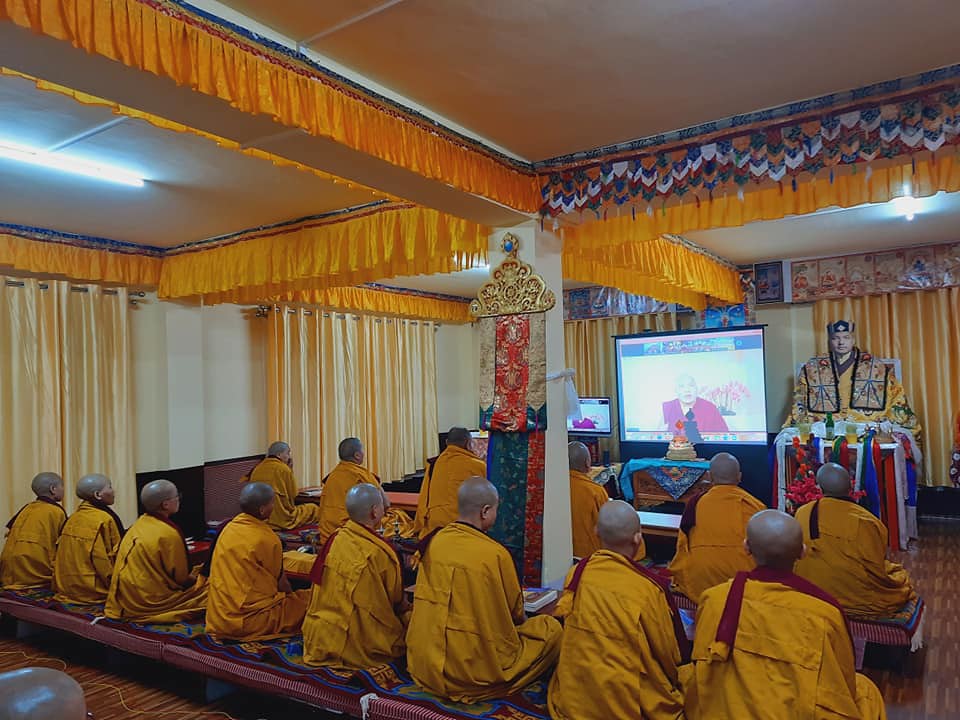
2021.03.04 Day 12: Je Tsongkhapa and the Kagyu; The Sixth and Seventh Good Deeds


  1. Day 8: Commitment to Study, the Fourth Good Deed, Travels and Miracles
  2. Day 9: The Fifth Karmapa Deshin Shekpa and the Ming Emperor Yongle 
  3. Day 10: Karmapa Deshin Shekpa, Karmapa Mikyö Dorje and China
  4. Day 5: Mikyö Dorje’s Second Good Deed

Page 2 of 5

  • 1
  • 2
  • 3
  • 4
  • 5
  • Home