






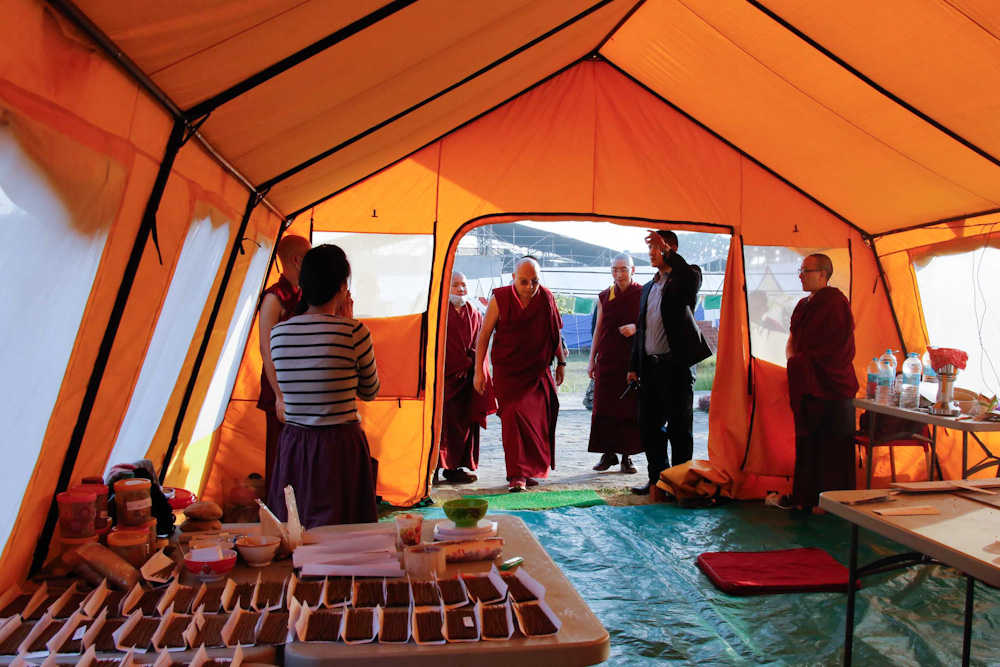



Hotel Anand International, Bodhgaya, Bihar
24-26 February, 2016
“It is of great concern to me that over the last sixty years so much of the priceless heritage of Tibetan Buddhism has vanished, not just through theft and deterioration, but because of lack of knowledge and skill in preservation. Over the last twenty years alone far too many irreplaceable works of art such as thangkas, statues, dance costumes, texts, and other sacred artifacts have been lost to future generations.”
– His Holiness 17th Gyalwang Karmapa
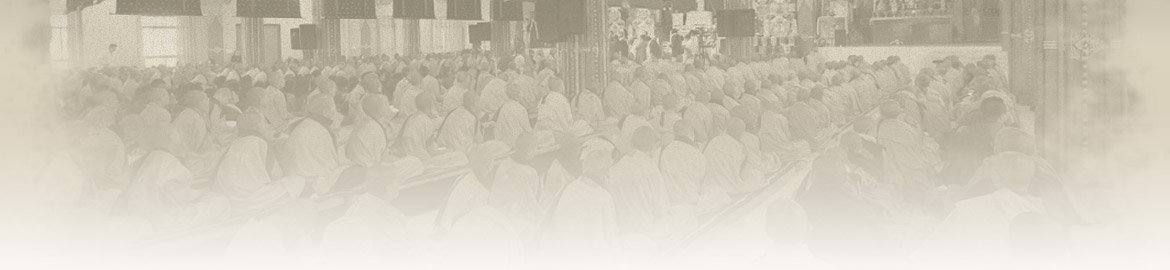
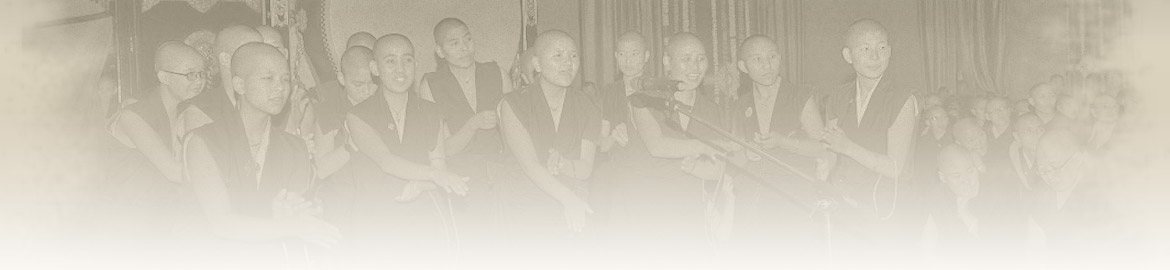
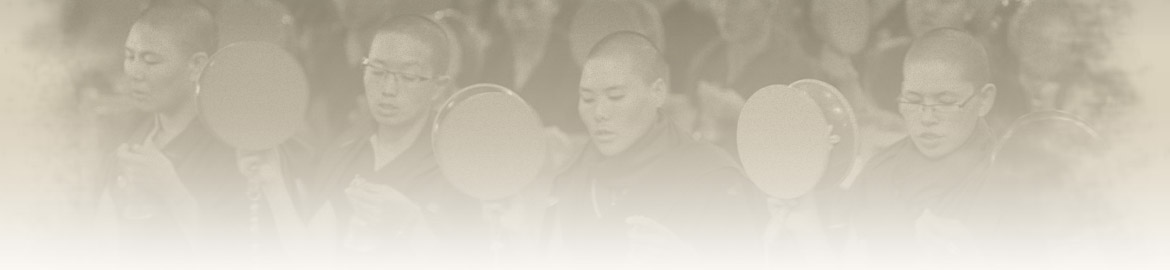
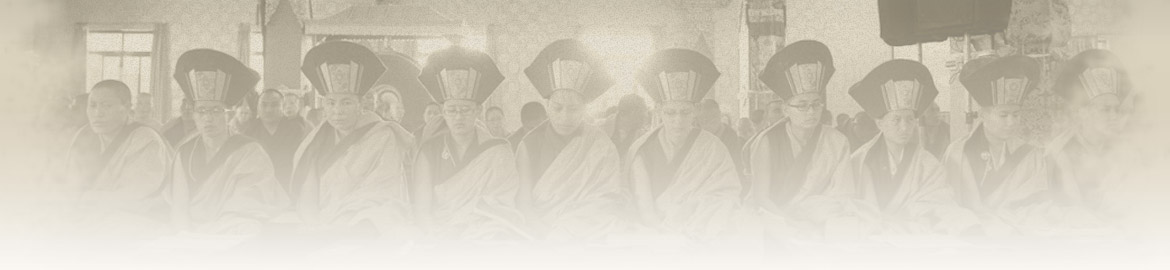
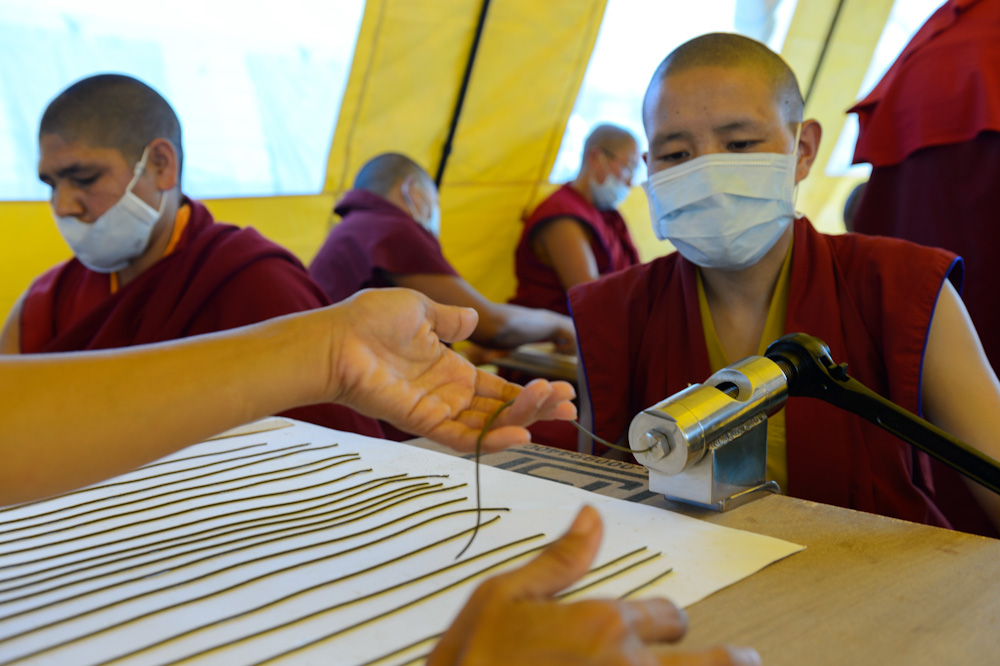
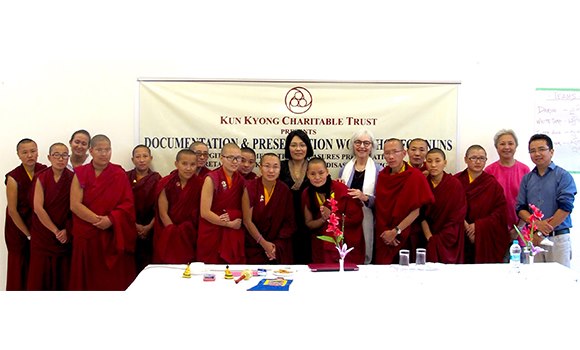
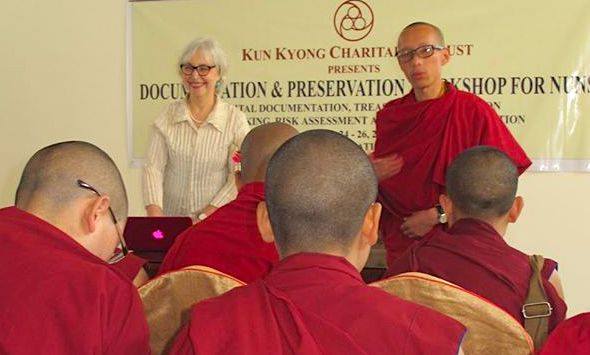
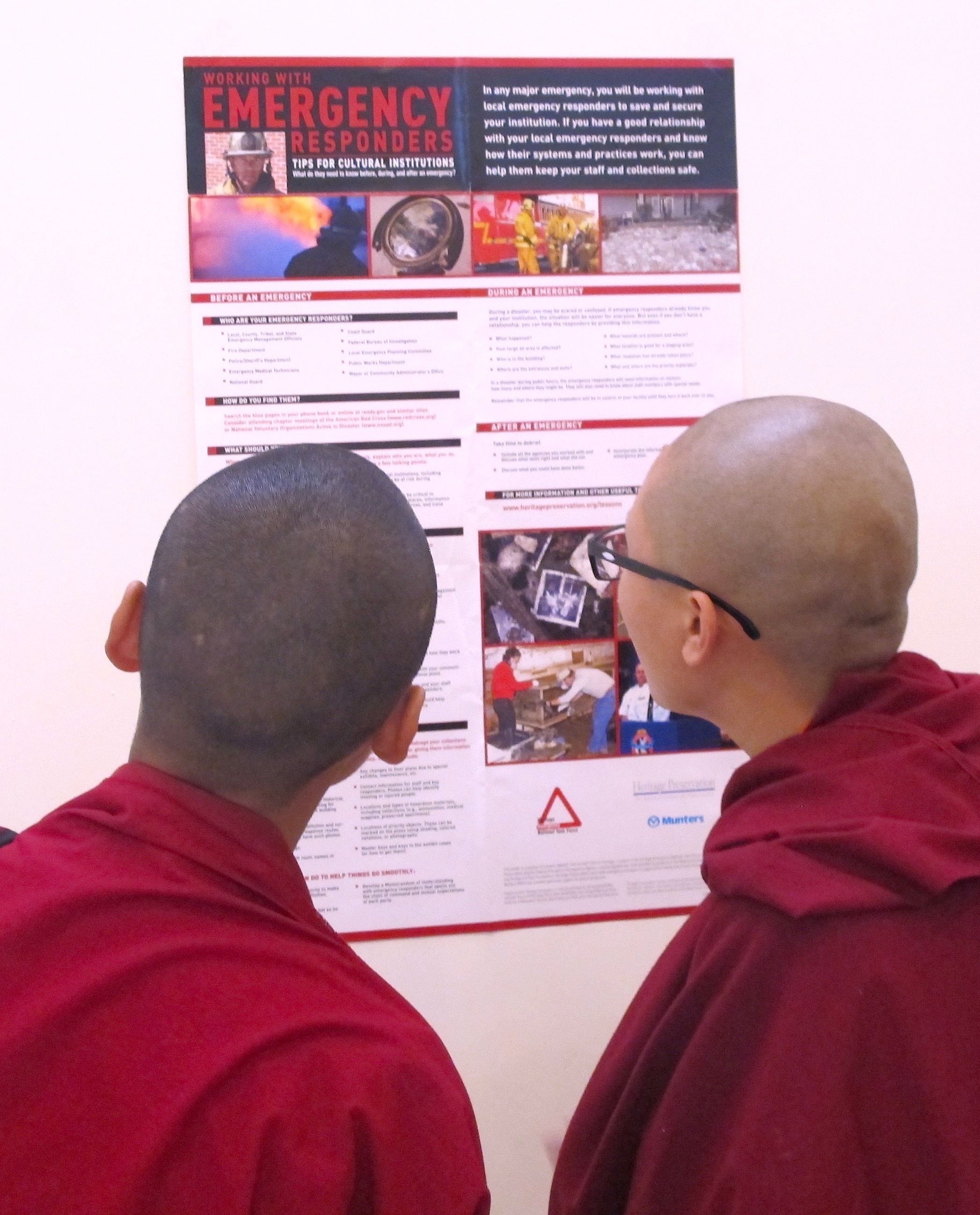
At the request of the Gyalwang Karmapa, a group of 17 nuns representing all eight Karma Kagyu nunneries completed an intensive three-day training to learn techniques for documenting and preserving the treasures owned by their nunneries, such as statues, thangkas, and texts. In addition, the nuns learned to interview and video-document elders about the history and significance of various treasures; the elders are in many cases the sole holders of this knowledge. The training took place at a hotel close to Tergar Monastery in Bodhgaya, following the completion of the Kagyu Monlam.
The program was organized and funded by the Kun Kyong Charitable Trust, of which the Karmapa is the primary patron. The trust began offering annual workshops for nuns last year, with the aim of teaching them skills that will help them to uphold the dharma. Last year’s workshop was on communication and leadership. An emphasis in this year’s training was also preparing the nuns to teach and share the information on treasure preservation with others at their nunneries. For example, two or three nuns were required to present their work after every group activity. Even over three days, the nuns’ confidence in standing up in front of a group and giving a presentation improved dramatically.
The director and lead instructor of the training, Ann Shaftel, became an expert in sacred art preservation at the advice of the 16th Gyalwang Karmapa, who told her “preservation of Buddhist paintings and statues is your Dharma work for this lifetime.” That advice propelled Shaftel to receive two graduate degrees and to eventually hold advanced international standing in the field of Art Conservation. During this time she has worked with dozens of monasteries and art museums to preserve sacred Buddhist tangible culture. She also developed this Treasure Caretaker Training—normally offered as a 10-day workshop—for training monks and nuns to become leaders in the preservation of their monastery collections.
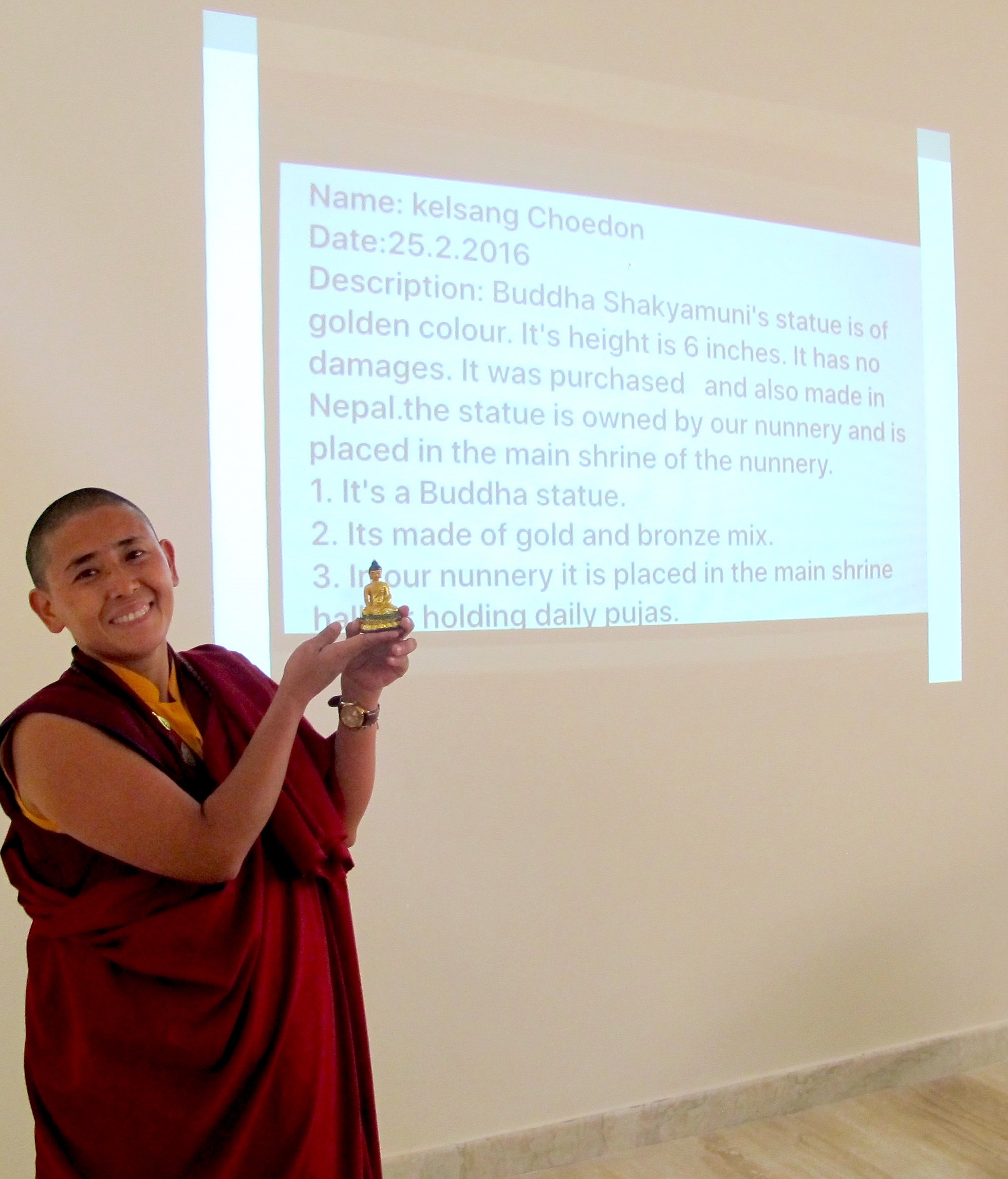
One of the main skills the nuns learned in the training was how to create digital documentation of all the treasures in their nunnery, including those in shrine rooms and storerooms. This means taking photographs (using their mobile phones) and creating notes regarding condition, dimensions, artist, how it is used in the monastery, and other details, for each piece. This information can be used to create a digital inventory, which most monasteries do not yet have. In the case they have difficulty getting access or using the technology, Shaftel also taught the nuns how to draw images and take notes on paper about each piece. “Better to have some documentation than no documentation,” she told them. However, with mobile phones being fairly ubiquitous now, and the hands-on experience they received through the training, the nuns seemed eager and capable of creating digital documentation at their nunneries.
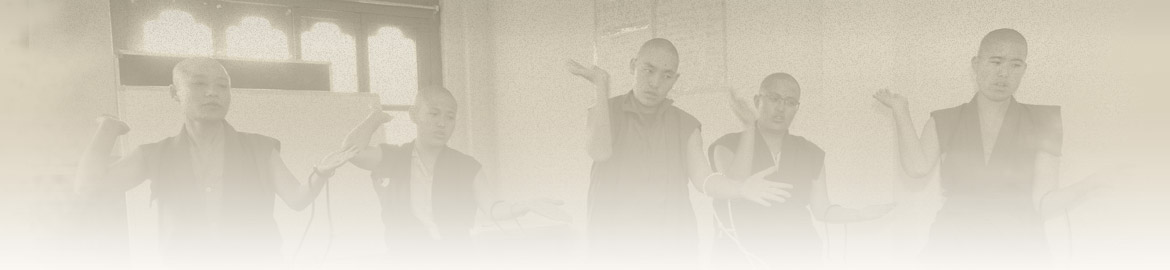
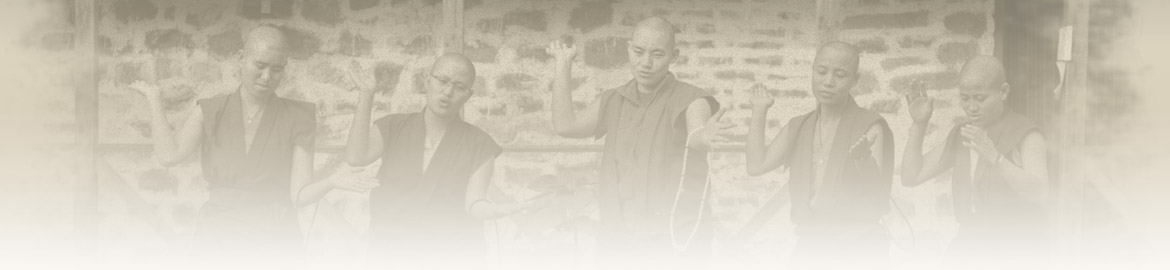
Notably the favorite part of the workshop for the nuns was learning how to interview elders about their treasures. The nuns took turns interviewing each other about their precious treasures (imagination was involved), while filming each other with their phones. Part of the interview training included making the elder comfortable and offering tea, and making sure to get their permission to film and share their stories. While this part of the workshop involved much laughter and fun, the training is critical for saving many stories passed through an oral tradition regarding the history and meaning of many sacred artifacts.
The nuns also learned practical tools for preventing damage and deterioration of the treasures in their storerooms. In particular, they learned about how to protect thangkas, texts, and other sacred objects from getting damaged by humidity, light, insects, and other factors. This knowledge is crucial for the nunneries that experience the monsoon season, when mold and humidity can create major problems for old texts and paintings. The nuns also learned labeling techniques. While it seems simple, many monastery storerooms lack proper labels, which can make things difficult to find. Without labels, certain objects can also be mysterious when found, if there is no documentation about what it is or where it came from and the oral history has been lost.
One of the topics Shaftel emphasized in the workshop was the importance of confidentiality. In the past, monasteries often avoided creating treasure inventories because of security issues; the reasoning being that if others knew what they had in their storerooms they would be at greater risk for theft. However, not having an inventory puts treasures at risk in other ways. For one, pieces can go missing with no one noticing. And during times of natural disaster or political upheaval—such as the recent earthquakes in Nepal—inventories help storeroom keepers to make sure nothing gets left behind or lost. Having an inventory also helps with organization; knowing where a precious thangka is in a storeroom helps one avoid digging through an entire box of thangkas looking for one, which damages the fragile paintings and fabric. The digital images can also aid in conservation, or re-creation, of the artwork in the future.
On the final day of the workshop, the nuns’ were delighted by a visit from Karmapa’s sister Chamsing Ngodup Pelzom, who offered some words of advice:
In all Buddhist traditions, it is said that we should not lean on others, but stand on our own two feet and walk along our path. Many of us have little education and come from small villages, but that should not stop us from trying to do whatever we can… to take advantage of whatever opportunities present themselves so we can become a model for others. A few nuns can make a big difference. You’ve received training, learned it well, and when you go back to your nunneries you will teach it to others so hundreds will benefit.
January 20, 2016 • Bodh Gaya, Bihar, India
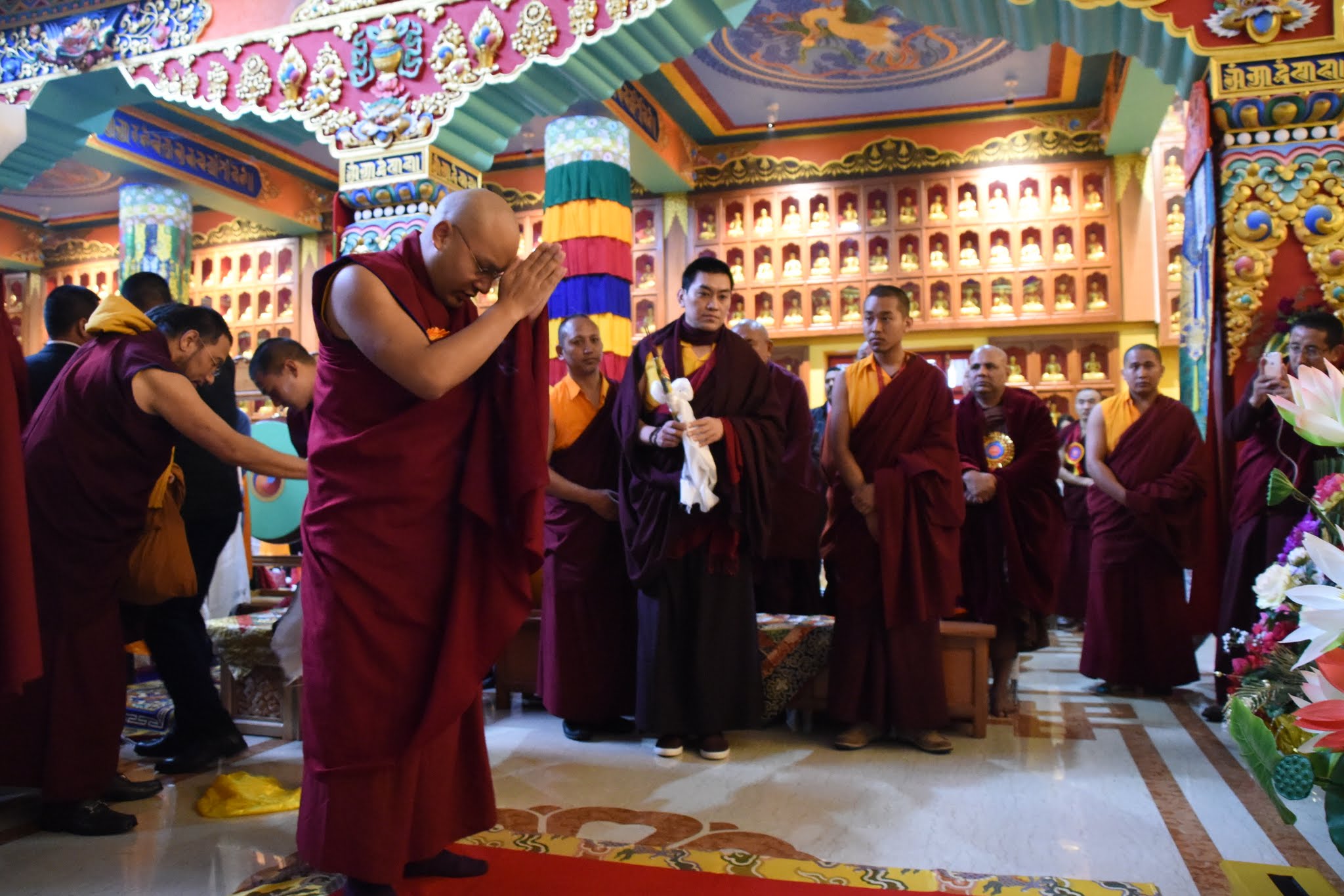
A beautiful new temple of the Nyingma lineage now graces the land of Bodh Gaya. The Gyalwang Karmapa was invited to consecrate this richly decorated hall of Ngagyur Palyul Shedrup Choekhor Dargyeling, built under the guidance of Kyang Khang Tulku. For this auspicious time, the beginning of the road to the temple was covered in a long white canopy; from it descended bright strings of pearls, crystals, and spheres of orange and gold—a shower of blessings to greet the Karmapa as he passed beneath. His entourage slowly moved past triple rows of nuns and monks holding white scarves before entering into the new temple.
This sacred hall is lined with golden statues depicting the one thousand buddhas of this fortunate era, and on the central altar is a large statue of Shakyamuni Buddha in the earth-touching mudra, flanked by Guru Rinpoche and Chenrezik. The Karmapa walked to the shrine for H. H. the Dalai Lama and there he lit a large silver butter lamp to begin the ceremony. After he had taken his seat on the high throne placed in front of the Buddha, a mandala and the supports of body, speech, and mind were offered to him along with prayers for his long life.
After other prayers, the Karmapa briefly addressed the rinpoches, khenpos, heads of local temples and dignitaries as well as the lay and ordained sangha present for the celebration. Warmly greeting all who had come, the Karmapa also extended his sympathy on the passing of Khyapje Chatral Rinpoche, who so greatly benefited the teachings in general and the Nyingma Dharma in particular. Looking around the hall, the Karmapa praised all those who worked on the construction for fulfilling Drupwang Penor Rinpoche’s wish to build a temple in Bodh Gaya, the most precious place on earth. The Karmapa prayed that from here, the teachings would spread and benefit all beings.
His talk was followed by supplications chanted with heartfelt devotion in Pali, Vietnamese, Korean, and Chinese, while the closing dedications were in Tibetan for the well-being of the world and its inhabitants as well as for the long lives of the lamas. Afterward the Karmapa descended from the ornately carved throne to bless the impressive statues with his prayers. Soon after he joined the special guests of honor for a festive lunch. Before returning to his residence at Tergar, the Karmapa gave individual blessings to the foreign guests in the newly consecrated shrine hall.

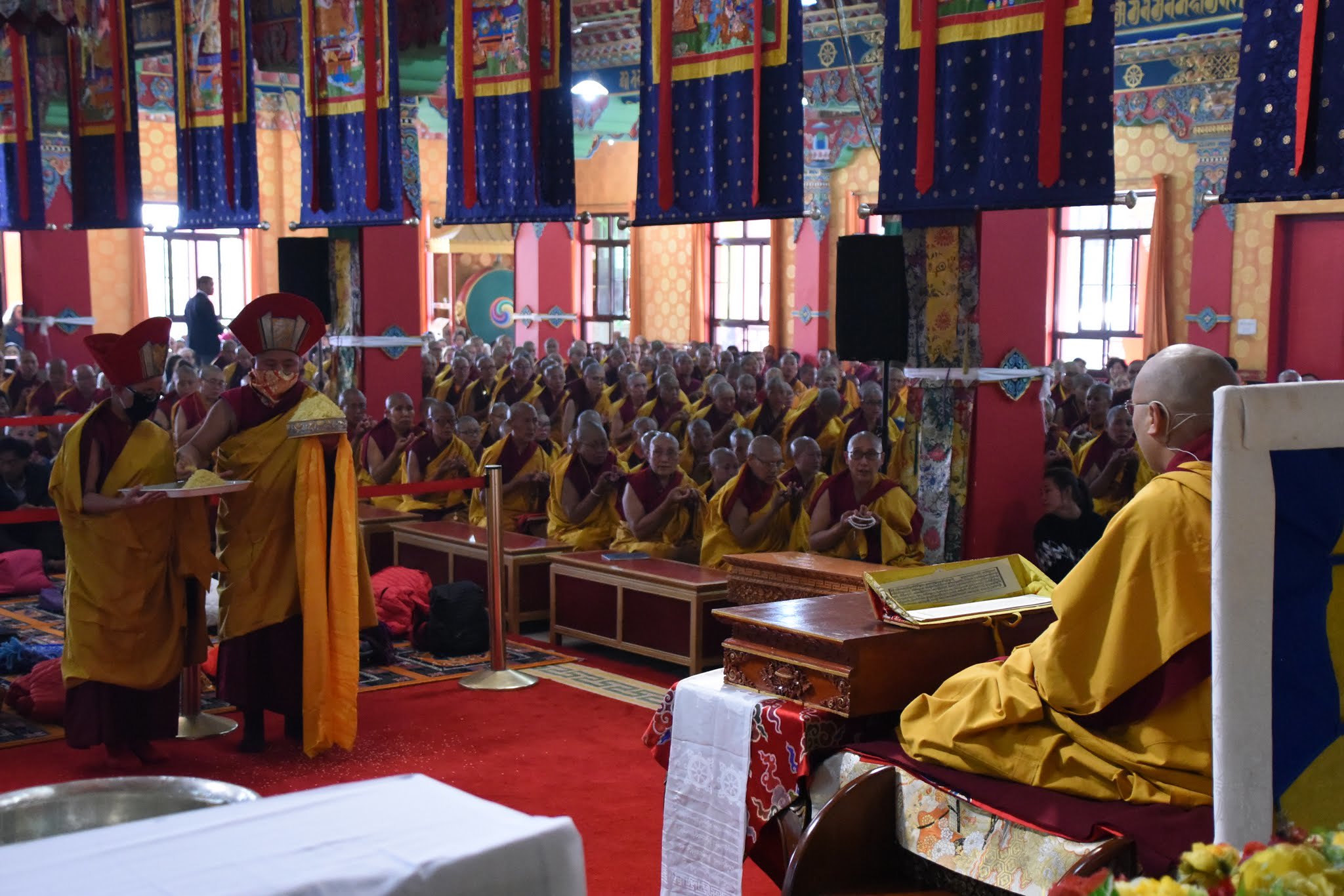
On a warm and sunny day, unusual for this time of year, the Third Arya Kshema Winter Dharma Gathering began with the Gyalwang Karmapa entering the main shrine hall at Tergar Monastery and offering three prostrations to its golden Buddha and to the life-like statue of the Sixteenth Karmapa resting on a throne on front. The hall itself was filled with over 410 nuns attending from nine nunneries in Nepal, India, and Bhutan. The sides of the hall were lined with observers including many nuns and lay women from all over the world. The webcast in English, Chinese, and Spanish made this morning’s session available to more than two thousand listeners.
The participants have come to hear the Karmapa teach every morning for fourteen days on Gampopa’s Ornament of Precious Liberation; they are seeking to improve their debating skills through daily teachings and practice; and, on top of daily observances, they will participate in four days of sadhana and ritual practices: White Tara Who Bestows All Siddhis; Karma Pakshi Guru Yoga; Offerings to the Five Long Life Sisters (Tseringma), and the extensive Chӧ Ritual, A Garland of Jewels, composed by the Third Karmapa Rangjung Dorje. On the last day, February 3, the nuns will engage in a closing formal debate. Further, on an astrologically auspicious day, they will perform a special puja for the flourishing of the nuns’ Dharma.
This full program of study, practice, and debate embodies the Karmapa’s wish that the nuns engage and become skilled in the three trainings of discipline, meditation, and wisdom. As he has said in the past, “I think it’s important for me to do everything I can to support the nuns’ teachings and practice, to help them develop their listening, contemplation, and meditation. So from the bottom of my heart, I want to put as much effort into this as I can. This is appropriate for me to do from now until the end of this lifetime as it fits well with the activities of the previous Karmapas, and it’s also clearly necessary in our contemporary society.”
Today, the nuns’ chanting began appropriately with the Heart Sutra and its praise of the Great Mother:
The Perfection of Wisdom beyond speech, thought, and expression,
The very essence of space unborn and unceasing,
The realm of experience for wisdom aware of its nature
To the mother of the buddhas in all three times, I bow.
Following an extensive mandala offering to His Holiness and his personal prayers, he began with thanks to everyone who had come from near and far and also expressed his appreciation to those who had made the gathering possible. He praised the nuns for their rapid improvement in the short time of two years and expressed his gratitude to them and their teachers for their interest and enthusiasm.
The Karmapa began today’s teaching on The Ornament of Precious Liberation with Chapter Nine, The Proper Adoption of Bodhicitta. He gave a reading transmission for its first pages on the essential nature of bodhicitta, and following a tea break, he began his explanations.
The reasons for studying this text are quite clear, he stated: we are followers of the Dakpo Kagyu, Gampopa’s own lineage (he is also known as Dakpo Lhaje, the Physician from Dakpo). Further, as he was about to pass away, Gampopa said to his disciples, “You all might be thinking, ‘People in the future will not be able to meet him.’ However, I have written texts, such as The Ornament of Precious Liberation and The Precious Garland of the Supreme Path. Studying them is no different from meeting me.”
The Karmapa continued to explain that the Dakpo Kagyu lineage is known as the confluence of the Kadampa tradition and Milarepa’s Mahamudra lineage; these two do not contradict each other and Gampopa taught them free of error. “These days, however,” the Karmapa added, “we do not pay much attention to the Kadampa side of the tradition and tend to forget their teaching on the three types of individuals. Yet Gampopa stated that his ability to benefit living beings was due to the kindness of the Kadampa.”
If we skip over these preliminaries or the common path, the Karmapa cautioned, and jump into advanced teachings like mahamudra, it will be quite difficult for our mind to be benefitted by them. “So we begin with the training in the three types of individuals,” he counseled, “and gradually work with our mind, improving ourselves to the point that we are well prepared to enter Mahamudra practice.” This way, he noted, the Dharma will function as Dharma (the second of Gampopa’s Four Dharmas).
The Karmapa then turned to Chapter Nine, The Proper Adoption of Bodhicitta, explaining that bodhicitta is the gateway to the mahayana: “Whether or not we have entered the mahayana depends on whether or not we have generated bodhicitta, which is indispensable. In the very beginning, we must have it and with it we can do everything.” He continued, “We should develop full certainty, unshakeable belief, that this is true by studying the scriptures, engaging in the logic, and thinking about the analogies.”
The Karmapa then spoke of the scriptures and first gave the condensed meaning of two important sutras. In The Purity of Maitreya Sutra, it is said that bodhicitta resembles a diamond: it does not change and, even if it were broken into fragments, they would be more brilliant than other jewels. The sutra also states that when bodhicitta has arisen within, without doing other practices, it can become a cause for full awakening. In the Gandavyuha Sutra, it is said that bodhicitta is the seed of all the Buddha’s qualities.
As for the treatises, the Karmapa explained that in Maitreya’s famed Ornament of Realization, the point about bodhicitta is the very first of all the seventy points that make up the text. Chandragomin speaks of bodhicitta as the path to happiness and the basis of the Mahayana in his Letter to Disciples. The great Tibetan masters from the past taught in their key instructions that if we have the wish for emancipation and bodhicitta that are stable and developed within our being, all our virtuous actions will become a cause for omniscience. Some masters add that bodhicitta is not only the gateway to the mahayana but also the entrance to the tantra of the mahayana as well. The Karmapa stated that in reflecting on these citations from the Buddha’s sutras, Indian masters’ treatises, and the writings of the Tibetan realized lamas, we can become certain that we could not do without bodhicitta.
The Karmapa then turned to indicating through logic that bodhicitta is the gateway to the Mahayana and gave several reasons. First, from the moment we generate bodhicitta, no matter what other qualities we might have, we have become a Mahayana practitioner, he said, and we are counted among the ranks of the bodhisattvas even if we do not engage in the conduct of a bodhisattva. Second, if we lose our bodhicitta, he cautioned, no matter what other qualities we might have, such as an understanding of emptiness, we descend to the level of the foundational vehicle, so the moment we are separated from bodhicitta, we have lost the mahayana path.
“What these reasons show us,” he said, “is that it is not enough for the Dharma to be the mahayana Dharma. It is important that individuals themselves enter the Mahayana.” With a mere understanding of bodhicitta, he noted, we will remain in a mere understanding of the mahayana. With authentic bodhicitta, our practice will be authentic Mahayana practice. “True bodhicitta,” he stated, “is the touchstone that determines whether or not we are real mahayana practitioners.
The major philosophical texts give long explanations of bodhicitta, the Karmapa noted, and there is much to understand from them, but for the sake of practice, an abbreviated definition is probably more useful. As he defined it, “Bodhicitta relates to our individual capacity, our mental strength or willingness, to take on responsibility for the sake of others.” We can say that we are Mahayana practitioners, he continued, but that does not really make us so. What does, he said, is our enthusiasm and ability to bear the responsibility of helping others. We should look to see if we have this or not. If we do, he explained, only then do we belong to the Mahayana.
The “maha” of mahayana means “great” or “big,” the Karmapa explained, but usually our bodhicitta is too small. To work for all living beings is not easy, he said, for it is hard to help one being to say nothing of all of them. “‘All living beings’ may sound impressive when we say it,” he cautioned, “but our minds cannot encompass the idea.” We may think to ourselves that we are doing quite well, but actually, he noted, we are not as great as we think. Forget about offering the ultimate benefit, it is even difficult to help on a relative level, he said.
What we can do, he advised, is train our minds to become strong so they can take on increasingly greater responsibility. This is the purpose of the well-known practices of mind training (lojong) and the graduated path. The Karmapa compared this training to that of developing physical strength. We start out lifting three, four, or five pounds, then eighteen and so on, gradually building our strength so that we can finally press a hundred. Similarly, there are the mental stages of daily practice that develop our bodhicitta and increase our ability to help others.
The Karmapa then told a story about a Tibetan who had a doubt about the practice of Sarvavid Vairocana (Kunrik in Tibetan). In old Tibet, he related, this was a popular text for purifying the lower realms so when a ritual was requested for the deceased, it was usually the Sarvavid so almost everyone had the text. The questioner asked the lama whether this practice belonged to the foundational vehicle (hinayana) or to the great vehicle (mahayana).
The lama replied, “In general the text, of course, belongs to the mahayana since it is a practice of the secret mantrayana.” However, the lama was clever and looking carefully at his questioner, he said, “But for the two of us the practice belongs neither to the great vehicle nor even to the foundational one.” The Karmapa explained, “Whether the Dharma we are practicing is the mahayana Dharma or not depends on whether the individual is really practicing the mahayana. So it is not just a question of the Dharma itself, but it depends on the individual practicing it.”
Then the Karmapa shifted the question: “If we asked that lama about the Dharma we have been practicing up to now, what would he say?” If the lama replied, “It’s not the greater or the foundational Dharma,” that would not be too bad, the Karmapa remarked, but if he said, “It’s not Dharma at all,” that would be problematic. So we must ask ourselves, the Karmapa said, “Is the Dharma I’ve been practicing up to now, the actual, true Dharma? Has the Dharma become the Dharma?” It’s not easy to answer this, the Karmapa said: “We should not be satisfied with the mere appearance of the Dharma, with a practice that reflects local customs, or one that is a fake in some other way. We have to look at ourselves and see if we can engage in actual practice, in the real thing, in what’s authentic.” With this probing question, the Karmapa ended the teachings on this first day.

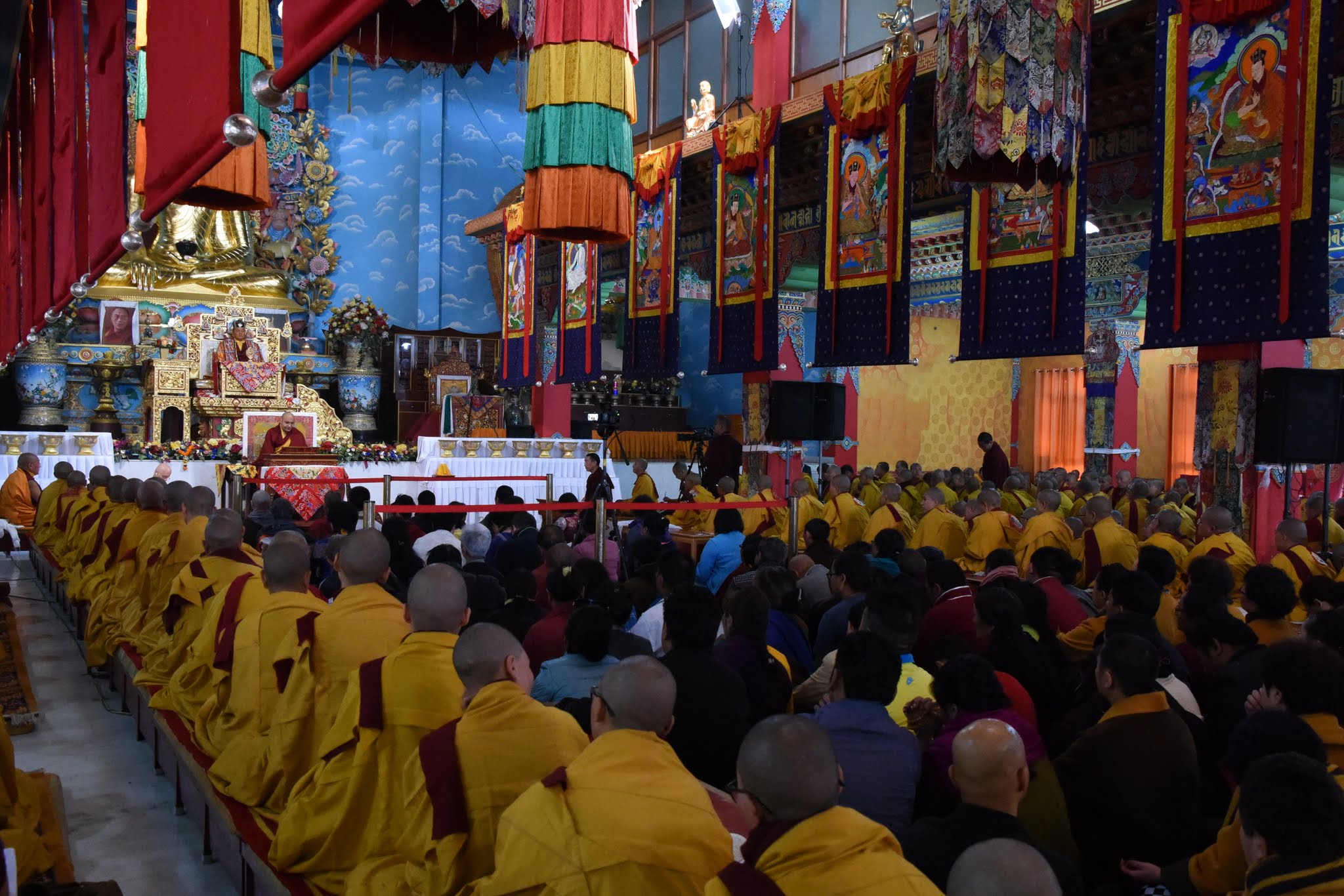
During the second day of the Third Arya Kshema Winter Dharma Gathering, the Gyalwang Karmapa continued his teaching on Gampopa’s Ornament of Precious Liberation, describing the causes for arousing bodhichitta. He also discussed the issue of the nun’s ordination, indicating that although he had hoped to initiate the process of giving bhikshuni ordination this year, it had to be postponed for a variety of reasons.
The teaching today was focused on the four causes of arousing bodhichitta presented in the Levels of the Bodhisattva by Asanga. The first cause of arousing bodhichitta is seeing or hearing of the powers of the buddhas and bodhisattvas. The Karmapa explained that for this reason, studying the life stories of buddhas and bodhisattvas of the past is important.
As an example, His Holiness told the story of Akshobhya Buddha. Before Akshobhya became a buddha, he made the aspiration that until enlightenment he would never be angry or perturbed by any sentient being. The Karmapa said that we need to consider deeply our own aspirations. To make an aspiration like Akshobhya’s to not become angry until Buddhahood is difficult to conceive for us ordinary beings. Therefore the Karmapa suggested we begin by making an aspiration to not become angry for a single day. Then gradually over time we can begin to develop the courage of Akshobhya.
The Karmapa also addressed the question of why it is necessary to become a perfectly enlightened buddha to benefit others. His Holiness quoted from Atisha’s Lamp for the Stages of the Bodhisattva Path, which says that to benefit other beings we must develop clairvoyance to know all aspects of their situation in order to really benefit them. Because bodhisattvas are not completely omniscient, when they work to benefit beings most, but not all, of what they do is successful. In contrast, everything that buddhas do to benefit beings is meaningful. Furthermore, the activity of buddhas is accomplished effortlessly and spontaneously.
The Karmapa emphasized that our aspiration to attain Buddhahood should not just be words—we need to look at the actual situation and understand the real benefit of achieving Buddhahood. If we develop this deep wish and remember it at all times, then achieving enlightenment will be possible.
Upon concluding his discussion of the text, the Karmapa set aside time to explain the latest developments in his plans to introduce full ordination for women in his lineage. His Holiness said there have been many rounds of discussion focused on whether or not it would be possible to confer bhikshuni ordination and what methods to use in doing so. The Karmapa said that it has now been determined that it is indeed possible, citing discussions at a 2015 conference in Dharamsala. He explained that in principle, agreement had been reached among senior heads of all Tibetan Buddhist lineages that it would be acceptable to hold bhikshuni ordinations conferred by a dual sangha consisting of monks from the Mulasarvastivada tradition practiced in Tibetan Buddhism and nuns from the Dharmagupta vinaya tradition.
The Karmapa noted that because the conferral of bhikshuni ordination to nuns in the Tibetan tradition is a significant step, it is important that it be done properly and carefully. Among the reasons for deferring the initial step is the fact that the upcoming year is considered by Tibetan society to be astrologically inauspicious. Now that it is clear that bhikshuni ordination will take place, His Holiness explained he would hold conferences this year to discuss how to proceed in practical terms.
